



Swiss millionaires are open to switching — these banks dominate
Competition for affluent private clients in Switzerland is intense. Around a quarter of wealthy investors have switched their main investment bank within the past five years.
This emerges from a joint study by the Lucerne University of Applied Sciences and Arts (HSLU) and Luzerner Kantonalbank (LUKB). For the survey, a total of 307 people with freely available assets of more than CHF 1 million were questioned in May this year.
The results reflect a market in which clients deliberately spread their assets across different institutions and remain flexible when choosing their bank.
On average, 3.3 banking relationships
According to the study, affluent private clients maintain an average of 3.3 banking relationships. They clearly distinguish between their main bank for payment transactions and the bank they use for securities investments.
For only about half of those surveyed is it the same institution.
UBS and the cantonal banks are particularly well positioned. Together, they account for the most important investment bank for 48 percent of respondents.
UBS accounts for the largest share at 27 percent, while the cantonal banks make up 21 percent (see also chart).
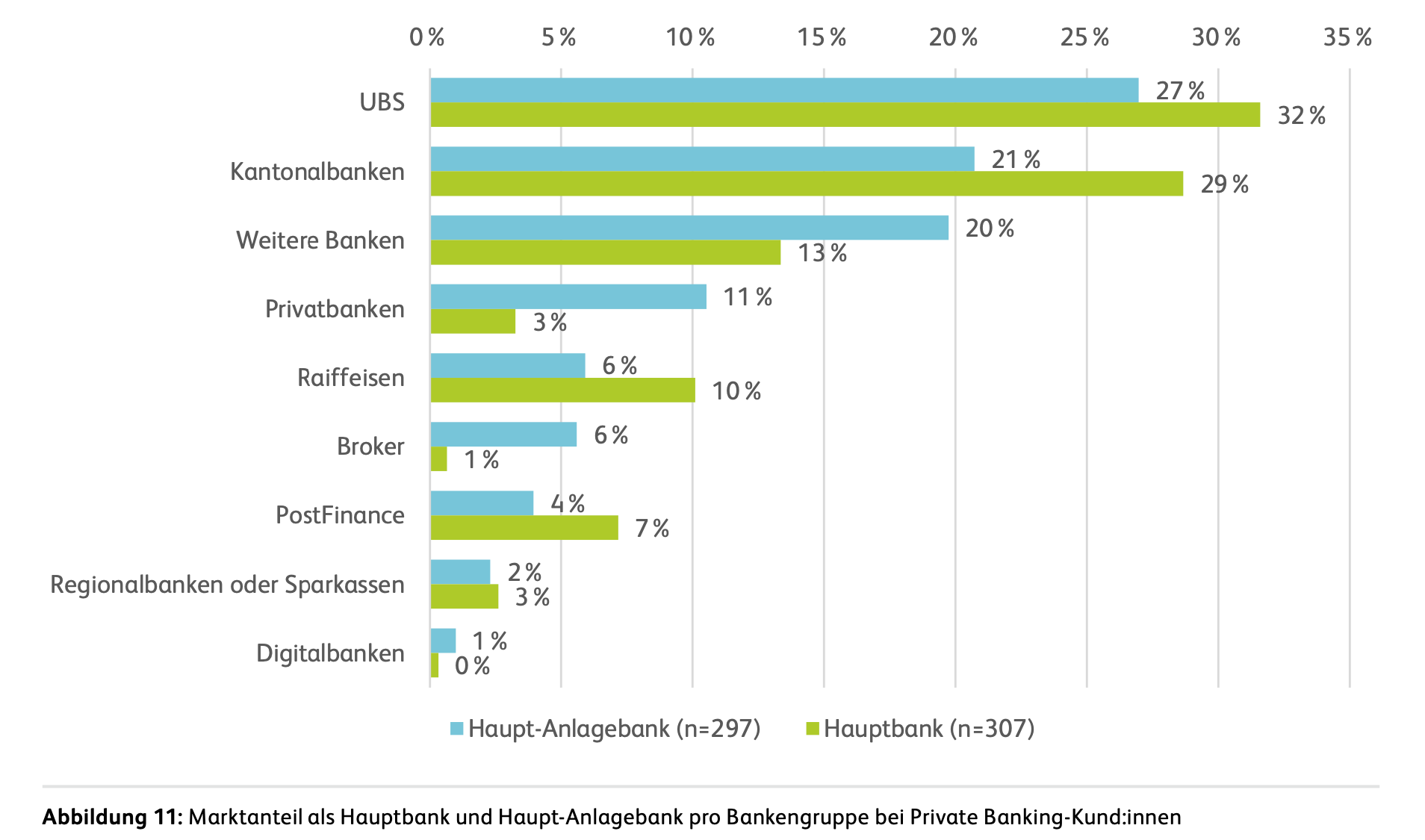
Neo and digital banks still play a minor role in the investment segment within this client group. Among younger wealthy clients, however, they are increasingly serving as a complement to traditional banking relationships.
That said, shifts could well occur in the coming years. According to the study, one in four has switched their main investment bank over the past five years. The authors attribute this in part to the disappearance of Credit Suisse.
Wealthy investors are significantly more likely to invest in stocks
The study also shows how strongly the investment behavior of wealthy individuals differs from that of the general population. While 52 percent of the Swiss population hold securities, almost all of the surveyed private banking clients do: 99 percent.
The difference is especially pronounced in stocks. Ninety percent of affluent respondents invest directly in stocks, compared with 35 percent in the general population.
Another 68 percent hold investment funds. Also noteworthy is the prevalence of more complex investment instruments: 39 percent invest in options, derivatives or structured products, and 32 percent in private debt or private equity funds.
Real estate also plays a significant role. Twenty-four percent of respondents own income-producing properties, while 53 percent invest indirectly in real estate.
Financially savvy clients also want advice
The millionaires surveyed rate their own financial expertise higher, are more interested in capital markets and react more calmly to short-term price losses than the general population.
Even so, according to the study, they by no means want to do without contact with their bank.
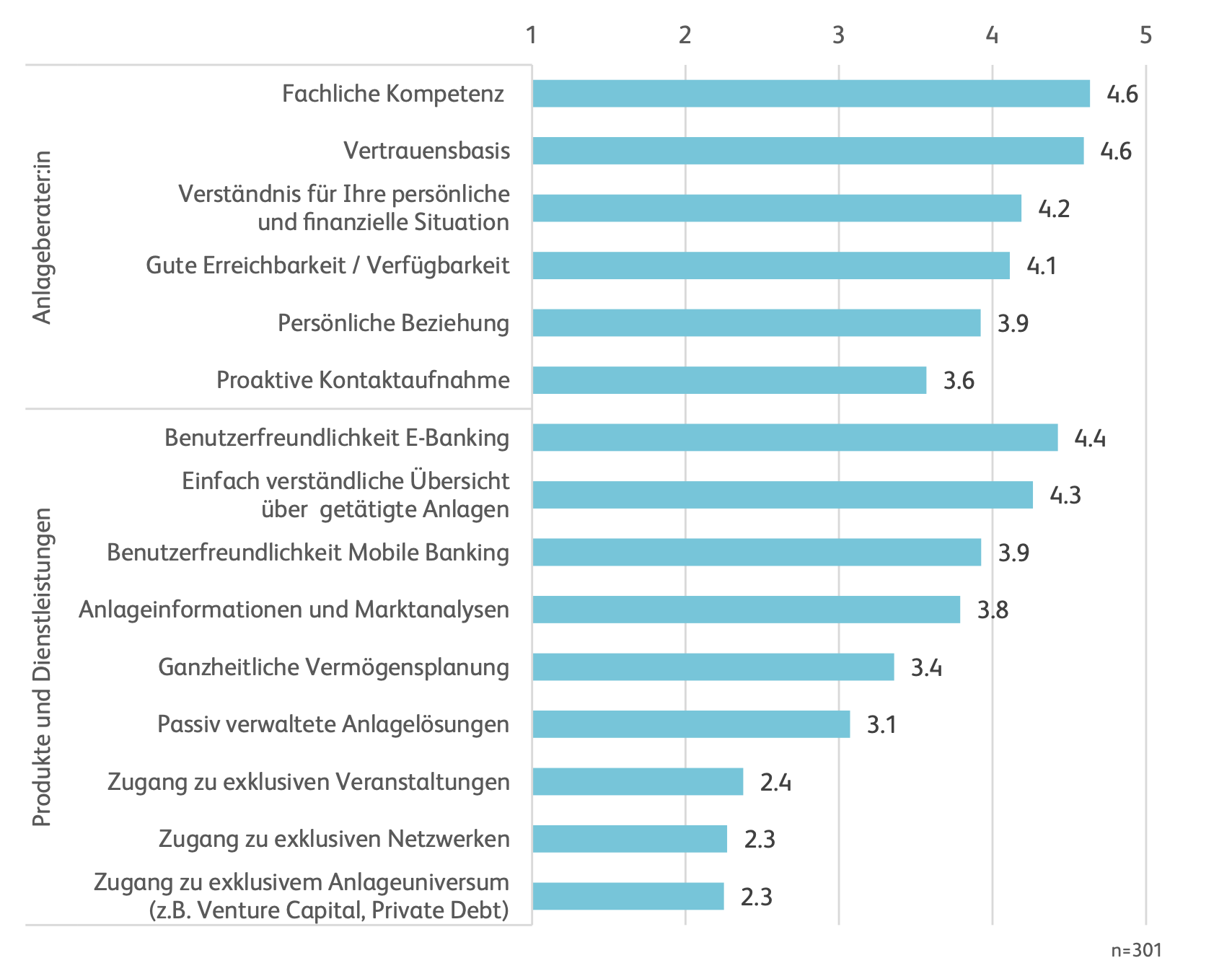
More than a third of respondents would like their investment adviser to get in touch at least once a quarter. What matters less is the highest possible frequency of contact than whether it is tailored to individual needs.
"Sparring partner on equal footing"
Désirée von Michaelis, member of the executive board and head of Private Banking & Corporate Clients at LUKB, sees this as an important insight for client service.
This also matches her observations in day-to-day business, she says in an interview with finews. "They see us as a sparring partner that interacts with them on equal footing," she says. That is what makes the role so exciting. The challenge is to determine who wants which type of advice. "There are clients who are glad when we are proactive and regularly present investment ideas to them, or remind them of retirement and estate planning; others, however, do not want this at all. Finding the right balance is what makes private banking successful," she says.
For respondents' satisfaction, above all the advisers' professional expertise, trust, the stability of the institution and transparent communication are decisive.
This matters more than exclusive client events and networking.


