


Cantonal banks overtake Raiffeisen – UBS loses
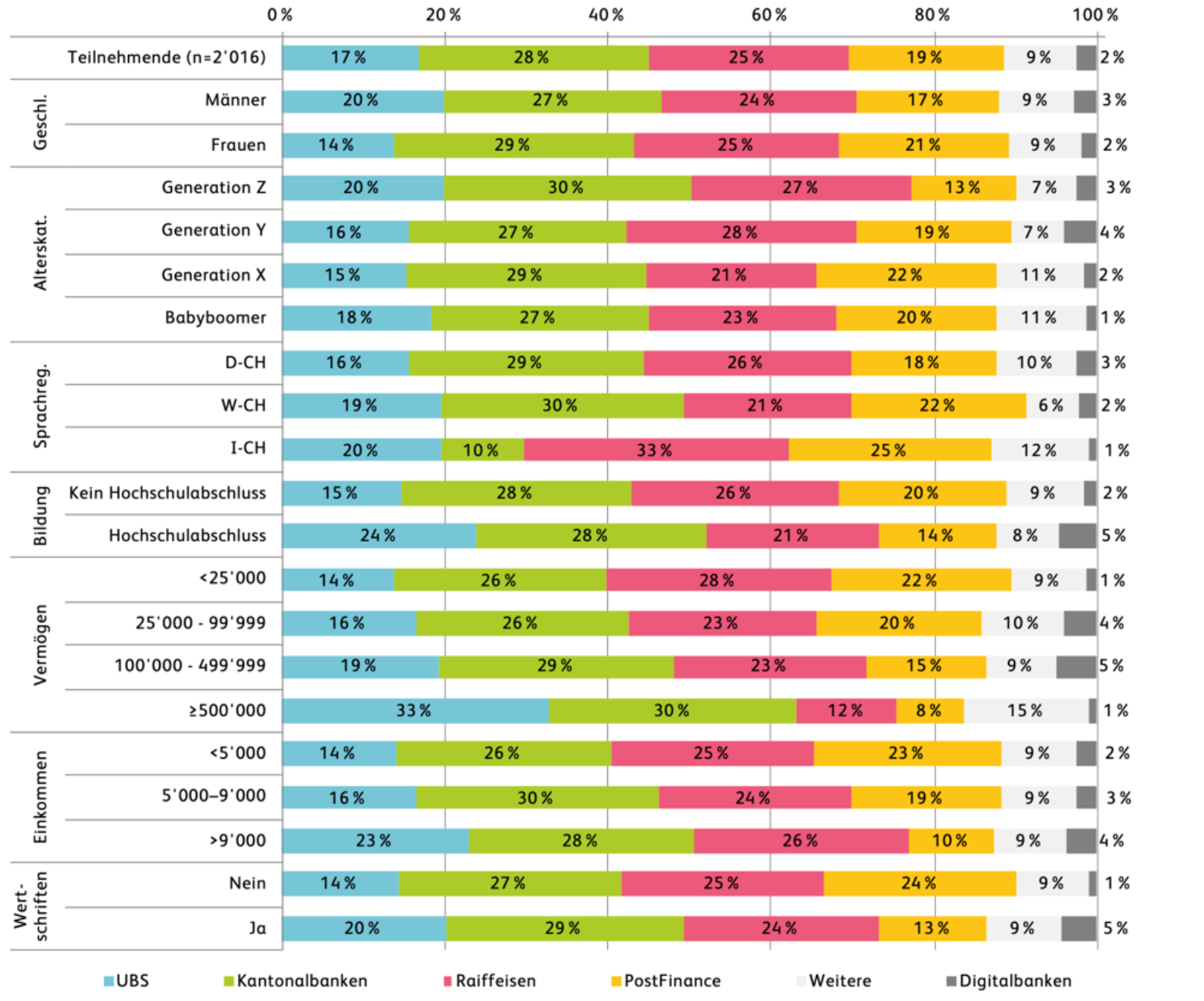
According to a new study by Lucerne University of Applied Sciences and Arts (HSLU), 28 percent of respondents name one of the 24 cantonal banks as their main bank. Two years ago, the figure was still around 26 percent. Raiffeisen follows in second place with 25 percent. Behind it are Postfinance with 19 percent and UBS with 17 percent. Together, these four provider groups account for 89 percent of main bank relationships in Switzerland.
The remaining banks, including regional banks, savings banks, Migros Bank and Bank Cler, account for around 9 percent combined. Digital banks and similar providers such as Revolut, Yuh or Neon account for just around 2.5 percent. UBS's development is particularly interesting. After the acquisition of Credit Suisse and the integration of its Swiss business, 17 percent of respondents currently name UBS as their main bank.
In the last comparable survey two years ago, the combined share of UBS and Credit Suisse was still around 20 percent. That corresponds to a decline of about three percentage points.
Large differences between language regions
The regional breakdown varies. In western Switzerland, cantonal banks are particularly strong, with a share of 30 percent. A different picture emerges in Ticino. There, only 10 percent of respondents name a cantonal bank as their main bank. Raiffeisen, by contrast, reaches 33 percent and UBS 20 percent.
Source: HSLU
UBS especially strong among wealthy clients
Income and wealth also play a role in the choice of main bank. Among people with assets of more than 500,000 Swiss francs, around one in three names UBS as their most important banking relationship. Among households with a monthly income of more than 9,000 Swiss francs, UBS's share stands at 23 percent.
Differences also emerge between the genders. While 20 percent of men name UBS as their main bank, the figure is only 14 percent among women. Women, however, are somewhat more likely to have their main banking relationship with a cantonal bank or Postfinance.
Postfinance is particularly common among people with lower incomes and assets. With assets of less than 25,000 Swiss francs, it accounts for 22 percent, while for assets of more than 500,000 Swiss francs, the share is only 8 percent.
Raiffeisen strong among younger customers
Different preferences also emerge across age groups. Raiffeisen reaches around 27 percent among 16- to 29-year-olds and 28 percent among 30- to 45-year-olds. Among older people, however, the share is around 21 percent.
Postfinance is particularly strong among older customers. In Generation Z, it reaches only 13 percent, while among 46- to 61-year-olds it reaches more than 22 percent. Cantonal banks show relatively stable shares across all age groups, ranging between 27 and 30 percent.
Digital banks remain primarily an addition
Despite rising user numbers, Revolut, Yuh, Neon and other digital providers still account for only a small share of main bank business. Around two years ago, the figure stood at 1.8 percent. It has now risen to just over 2.4 percent. That corresponds to an increase of around 0.6 percentage points. Among 30- to 45-year-olds, digital banks already account for 4 percent. Among baby boomers, by contrast, the figure is only 1 percent.
Educational attainment also plays a role: Among people with a university degree, 4.7 percent name a digital provider as their main bank, compared with 1.8 percent among people without a university degree.
More than 2,000 people surveyed
The results are based on a representative online survey of 2,016 people aged between 16 and 89. It was conducted by the market research institute Bilendi from May 29 to June 11, 2026. The study was conducted as part of the IFZ Retail Banking study at Lucerne University of Applied Sciences and Arts in cooperation with the management consultancy Simon-Kucher.


