



MBaer: how the liquidation eats the bank
The MBaer saga heads for a showdown on December 3: liquidators Daniel Staehelin and Lukas Bopp of Kellerhals Carrard will face the shareholders of MBaer Merchant Bank at Zurich's Kongresshaus. It is the first shareholders' meeting since the regulatory kill shot.
In early February, Finma stripped the bank of its license, a decision the bank challenged before the Federal Administrative Court. In late February, the US Financial Crimes Enforcement Network (FinCEN) declared the small Zurich bank a "primary money laundering concern," based on allegations that look thin on closer inspection (finews reported).
Within hours, J.P. Morgan cut the dollar connection. The bank withdrew its appeal against Finma's ruling, and the board of directors resigned en bloc.
Finma as shadow board
Since then, the liquidators have run the bank, with Finma acting as a kind of shadow board.
finews has now obtained the 2025 annual report on which shareholders are to vote. The key passage is Note 5.16 in the notes to the financial statements. According to the liquidation plan dated May 15, 2026, winding down the bank will cost 66.8 million francs. Of that amount, 30.7 million are ordinary costs that would have been incurred in normal operations as well.
Another 36.1 million is directly attributable to the liquidation. On top of that come 10 million francs for potential damage claims and a general provision.
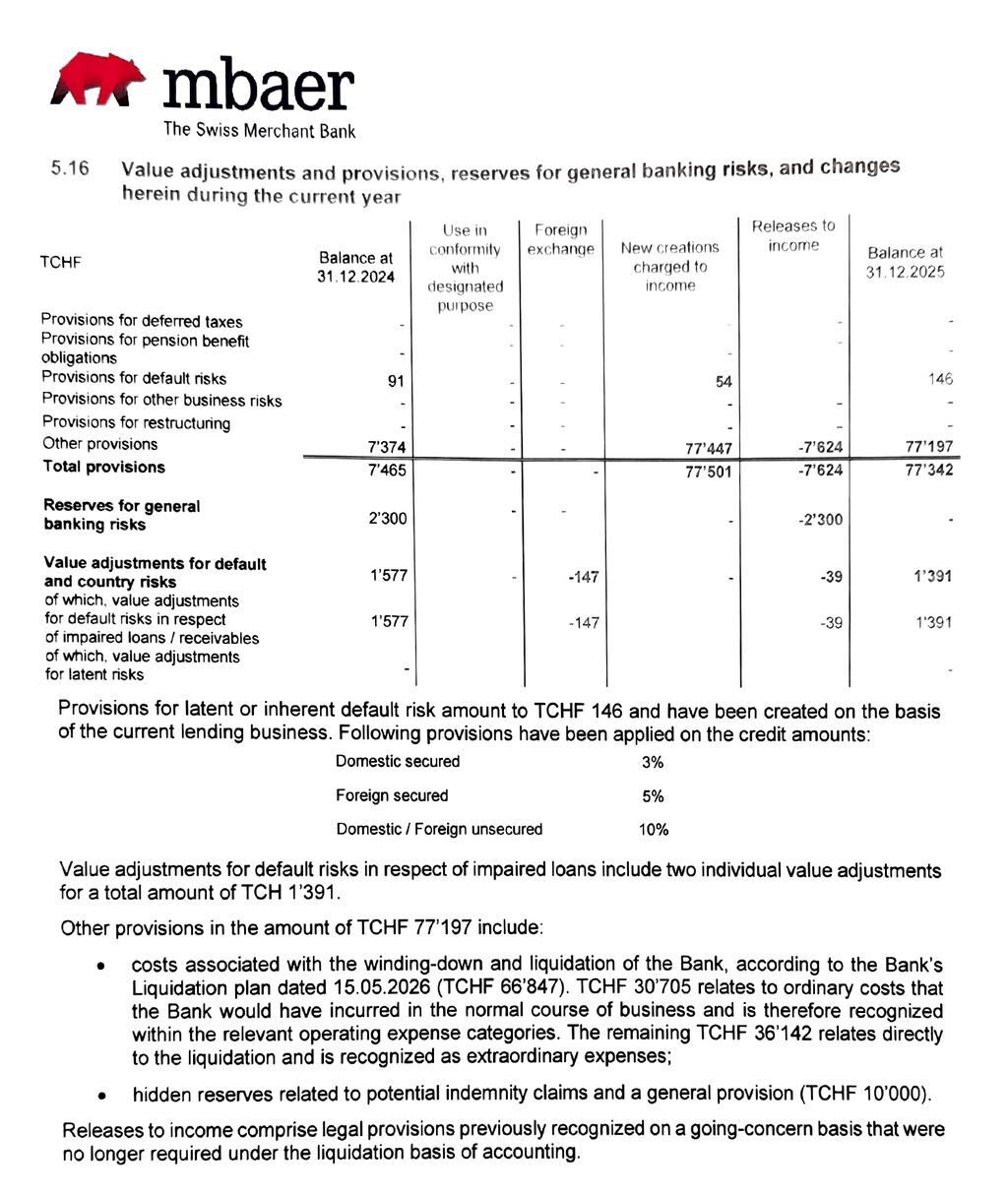
Provisions for the wind-down: Note 5.16 in the 2025 annual report of MBaer Merchant Bank. (Image: finews, click to enlarge)
A costly exit
In September, finews described how the liquidation was moving at a snail's pace: of roughly 5 billion francs in client assets, only about 30 million had been paid out at the time. According to sources, around 11 million francs had been budgeted for the liquidators' fees, with proceedings expected to last about ten years (finews reported).
The provision hits the 2025 accounts in full. The bank reports a loss of almost 60 million francs, which shrinks equity from 63.8 million to 2.2 million francs. Auditor BDO issued only a qualified opinion: with an additional value adjustment on a client receivable, equity would come to a mere 1.06 million francs.
A warning from the auditors
BDO also points to a material uncertainty in the assumptions underlying the liquidation: "Unfavorable developments in the realization of assets, in the outcome of legal disputes or in the duration and costs of the liquidation could cause the company's liabilities to exceed its assets."
Will shareholders end up with only whatever equity the liquidators, advisers and Finma leave behind?
Finma waves it off
Responding to a finews inquiry addressed to the liquidator, Finma, which oversees the proceedings, said that "based on the liquidator's valuation, there is no threat of overindebtedness." Under the imparity principle, the accounting rule that requires losses to be anticipated but not gains, the liquidator was permitted to budget only for expenses, not for income from fees and interest during the liquidation.
Indeed, the bank continues to charge its remaining clients management and custody fees, which at 2025 levels came to about 20 million francs.
Client payouts by 2027 at the latest
Finma further writes that clients with a valid payout request and no frozen account "are to be paid out in the course of 2027 at the latest."
The regulator declined to disclose its own fees in the liquidation. "Finma does not provide any information on the fees it has already invoiced," it wrote. The liquidation balance sheet must also include "a provision for the costs related to Finma's activities," it added, and this is reflected in the liquidation plan as well.
Voting before the briefing
The meeting will show what shareholders make of the accounts. According to the documents, the liquidation could consume their equity.
The order of the agenda also raises questions. Shareholders vote on the annual report under agenda item 3. Only afterward do the liquidators present the opening liquidation balance sheet and the liquidation plan, along with the progress of the liquidation to date. The latter two are not put to a vote. Shareholders are thus voting on the provision for the liquidation before they know where it stands or what the plan is.
No independent proxy
There is no independent proxy. According to Finma, the liquidator does not consider one necessary, since under the articles of association every shareholder may be represented by a third party. Nor is a board of directors up for election, even though the previous board resigned en bloc on February 27. The liquidators point to Finma's oversight.
And although Finma itself speaks of a liquidation under the Swiss Code of Obligations, it sees no reason to formally fill the supervisory body of the company in liquidation: "The liquidators each represent MBaer Merchant Bank with sole signing authority."
The meeting will be held exclusively in German, with no translation provided.
Solid business, visible skid marks
Operationally, the bank did not fare badly in 2025. Stripping out the ordinary costs brought forward, the operating result comes to 15.3 million francs, roughly in line with the previous year. Assets under management rose slightly to 2.07 billion francs, plus 2.7 billion francs in pure custody assets.
MBaer Merchant Bank: the 2024 and 2025 figures
| in million francs | 2024 | 2025 |
| Equity | 63.8 | 2.2 |
| after value adjustment required by BDO | 1.06 | |
| Net result | 10.6 | -60.0 |
| Provisions | 7.5 | 77.3 |
| of which wind-down under liquidation plan | 66.8 | |
| of which damage claims and general provision | 10.0 | |
| CET1 ratio (percent) | 41.6 | 1.4 |
| Total capital ratio (percent) | 42.2 | 2.0 |
| in million francs | 2024 | 2025 | Change in percent |
| Net interest income | 19.5 | 10.0 | -48.8 |
| Net fee and commission income | 26.6 | 21.5 | -19.2 |
| Net trading income | 11.2 | 6.3 | -44.2 |
| Operating income | 57.3 | 37.7 | -34.2 |
| Operating expenses | 35.6 | 55.5 | +56.2 |
| of which ordinary liquidation costs brought forward | 30.7 | ||
| Operating result | 15.0 | -15.4 | |
| Operating result excluding liquidation costs brought forward* | 15.0 | 15.3 | +1.9 |
| Extraordinary expenses | 0.0 | -46.0 | |
| Net result | 10.6 | -60.0 |
* finews calculation: operating result plus 30.7 million francs in ordinary costs under the liquidation plan, already booked in 2025 operating expenses.
| in million francs | 2024 | 2025 | Change in percent |
| Assets under management | 2,005 | 2,066 | +3.1 |
| of which discretionary mandates | 138 | 109 | -20.7 |
| of which without mandate | 1,867 | 1,957 | +4.8 |
| included therein, not additive to the items above: | |||
| Client deposits | 566 | 481 | -15.1 |
| Fiduciary investments | 205 | 133 | -35.2 |
| Net new money | -124 | -85 | |
| Custody assets (safekeeping only)** | n/a | 2,700 | |
| Total client assets | n/a | 4,766 | |
** Reported in the annual report as "CHF 2.7 billion"; not disclosed for 2024.
Source: 2025 annual report of MBaer Merchant Bank in liquidation; compiled by finews
Even so, the skid marks left by the clean-up of the client book, carried out under Finma's watch, are unmistakable. Around 30 percent of clients left the bank in the process (finews reported). Operating income fell by a third in 2025, and net interest income halved. Client deposits declined by 15 percent. At the same time, the bank expanded its legal and compliance staff from five to 12 full-time positions.
A clean-up with consequences
For the liquidators, however, cleaning up the client book was not enough, even though, according to information obtained by finews, it was carried out as part of a remediation that Finma ultimately approved. In a letter to clients dated October 27, which finews has seen, they state: "Unfortunately, the remediation measures taken by the bank in 2025 in a large number of files were inadequate." The measures, they write, neither prevented the license revocation nor made a fresh review of clients unnecessary.
The liquidators point to the "exceptionally high risk" of the client base. A new review of all files before any payout is also being demanded by the Swiss commercial bank that processes the payments, as well as by the securities settlement agent. According to the letter, several external specialists and a large consultancy for financial service providers are involved.
Mail for MROS
The review is having consequences. "In numerous cases, the liquidators, following their review, have filed reports with the Money Laundering Reporting Office Switzerland (MROS)," the letter states. The cases involve assets of unclear origin or questionable transactions. MROS forwarded most of the reports to public prosecutors, and in several cases assets were frozen. Specifics, however, are not available (see box at the end of this article).
At the same time, the liquidators play this down. It does "by no means" mean that all cases not yet paid out were reported to MROS, they write. The main reason for the long delays, they say, is the sheer number and complexity of the files. They also cite the information ban under the Anti-Money Laundering Act, which applies once a report has been filed or is about to be, as one reason why they give clients no payout date.
A warning to clients
For MBaer clients considering legal action against the bank, the liquidators have a warning. The Zurich Commercial Court recently dismissed the claim of a client who had sought the immediate payout of his assets in summary proceedings for clear-cut cases. The court found that the comprehensive pre-payout review, and the time it takes, were sufficiently justified.
Yet these proceedings under Article 257 of the Swiss Civil Procedure Code are "the only legal instrument that could in principle give a client a time advantage over the regular review of his file," the liquidators write. In plain terms: suing is unlikely to get anyone their money faster.
Federal prosecutors: more smoke than fire
Prosecutors, too, had positioned themselves early on. In early April, Attorney General Stefan Blaettler told reporters in Bern that the bank's name was not unknown to his office. Preliminary inquiries were underway, he said, and the Office of the Attorney General would release further details shortly, as Bloomberg, among others, reported (article behind paywall).
A good half-year later, little of that remains. By its own account, the Office of the Attorney General is not conducting a criminal investigation into the former MBaer or its former employees, as Tippinpoint noted in late October (article in German).
The allegations have been folded into ongoing proceedings and preliminary inquiries against several individuals and against persons unknown. That can also be read as a sign that the spectacular allegations from Washington involved more smoke than fire.
The liquidators will answer further questions from finews only at the shareholders' meeting. "It would not be right for the public to be informed first and the shareholders only afterward," Finma writes.
Open questions
The questions Finma and the liquidator leave unanswered
Until the shareholders' meeting, the following remain open:
- What explains the size of the provision, and how long does the plan expect the liquidation to take?
- What share of the costs goes to the liquidators' fees, to Finma, and what share to external advisers?
- Why was the 1.12 million franc value adjustment required by BDO not booked?
- Which potential damage claims does the 10 million franc provision cover?
- How many client relationships have been closed, and how much money has been paid out so far?
- How many debt enforcement proceedings and lawsuits over the payout of client assets are pending?
- How many reports have been filed with MROS, and in how many cases were assets frozen?
- How many client relationships with sanctioned individuals or companies exist, and how are the liquidators handling them?
- Against which former officers has the statute of limitations on liability claims been interrupted?
finews inquiry to liquidator Daniel Staehelin and Finma, November 19, 2026


