



Switzerland faces record high in corporate bankruptcies
Corporate bankruptcies in Switzerland are expected to reach a historic record in 2026: Allianz Trade is according to a recent study expecting around 15,000 cases. That is more than double the figure for 2022 and roughly three times the average before the coronavirus pandemic. In addition to economic pressure, the new insolvency law in force since 2025 is also contributing to the increase in Switzerland.
"The new insolvency law is largely responsible for the high number of insolvencies," says Jan Möllmann, CEO of Allianz Trade in Switzerland. It is leading to a mechanical increase in proceedings. The company expects a normalization at the new, high level in 2027 and 2028.
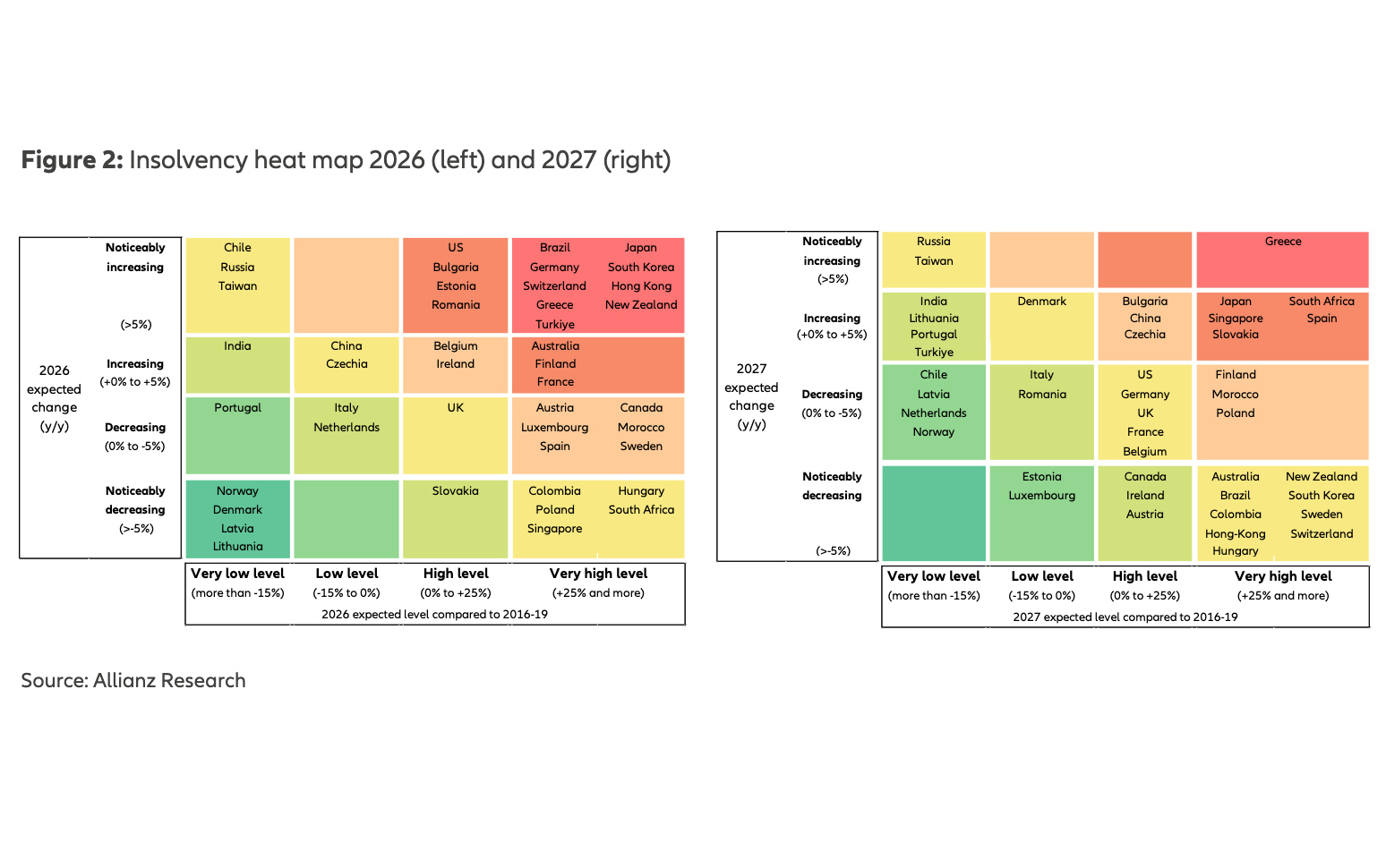
Pressure factors include weaker-than-expected economic growth, high energy costs and persistently higher interest rates. In addition, the rising number of active companies is intensifying competition and putting particularly younger, financially less stable firms under pressure.
Europe particularly hard hit
The insolvency trend also remains tense across Europe. Global corporate bankruptcies are expected to rise by 5 percent in 2026 and by another 1 percent in 2027. That would make it the fifth consecutive year of growth. Allianz Trade does not expect a slight decline of 1 percent until 2028.
The consequences for the labor market are significant: Globally, around 2.7 million jobs are expected to be directly at risk from corporate bankruptcies in 2026 and 2027 combined, 180,000 more than in 2025. Europe accounts for just under 60 percent, or 1.6 million jobs. France, Germany and the United Kingdom are particularly affected. In North America, another 650,000 jobs are at stake.
Above all, construction, retail and the services sector are at risk. Higher financing costs and persistently high energy prices are adding further pressure to margins. In Western Europe, a 1 percentage point increase in bank lending rates could result in additional interest expenses of 6 billion to 10 billion euros, according to Allianz Trade.
AI could intensify competitive pressure
According to the analysis, the use of artificial intelligence (AI) has so far not been a general driver of corporate bankruptcies. However, in smaller and less diversified markets, the technology could accelerate structural change because companies that adopt AI early gain competitive advantages over late adopters.
In Belgium and Sweden, where the AI adoption rate in the sample analyzed is 35 percent, Allianz Trade recorded particularly high numbers of insolvencies in highly digitized sectors. The information and communications sector, where the AI adoption rate reaches 70 percent, also shows above-average insolvency figures in five of the eight countries studied.
The analysis covers eight EU economies and nine sectors. Allianz Trade emphasizes that macroeconomic conditions and sector-specific factors remain the most important explanatory variables for insolvencies. However, AI could amplify existing differences between companies, especially where markets are less diversified and firms have only limited resources for digital transformation.


