



IAZI: Pressure on Swiss residential property market remains high
"One of the stabilizing factors is the great uncertainty and the global crises in other regions of the world," said Donato Scognamiglio of IAZI at a media event on Tuesday in Zurich. Confidence in Switzerland is driving demand here, on the one hand through investment and immigration.
Developments in other countries are also influencing mortgage interest rates in Switzerland. Despite the SNB's "still" ongoing zero-interest-rate policy, average interest rates in Switzerland are around 1.5 percent.
Net immigration to Switzerland has been declining continuously since 2023. This has led to somewhat lower demand pressure, especially in the rental market. However, this development is meeting simultaneous weakness in residential construction. After new construction, conversions, and demolitions, net housing production recently amounted to around 41,000 units. As recently as 2018, this figure reached a peak of around 55,000 apartments.
Price increases in Switzerland continued unabated
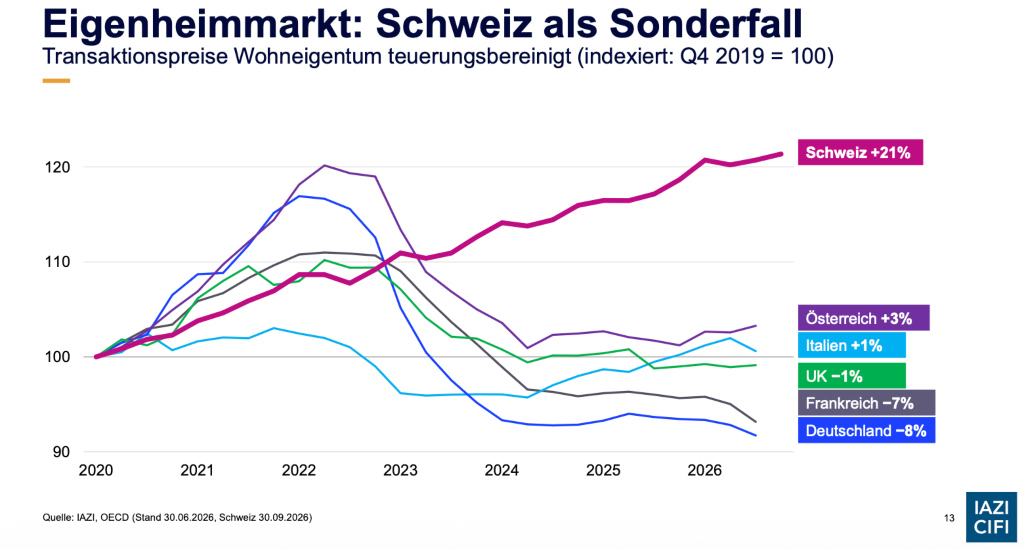
Compared with other European countries, Switzerland is something of an exception in the development of owner-occupied housing prices. While indexed prices in Austria, Italy, France, and Germany have declined since 2022, price increases in Switzerland continued unabated. Since the fourth quarter of 2019, transaction prices in Switzerland have risen by around 21 percent. In Germany, they have fallen by 8 percent and in France by 7 percent since then.
Significant regional differences were also observed in Switzerland. According to the data, price growth in Central Switzerland has been the strongest since 2016 at +58 percent, followed by Zurich (+50 percent). The weakest development was seen in Ticino, with an increase of 14 percent.
One reason for the strong price trend and the increase in rents is the low vacancy rate. Nationwide, it currently stands at 0.9 percent, according to IAZI. "At a level of 1 percent, we speak of a housing shortage," said the head of IAZI. "In Zurich, the vacancy rate is 0.1 percent, in Zug 0.2 percent, and in Geneva 0.3 percent."
This creates strong pressure on asking rents. While these have risen significantly over the past two years, existing rents have barely changed and have recently even partially declined due to adjustments in mortgage interest rates. "Those who move lose," said the head of IAZI.
One trend that has also emerged in recent years is the outflow of the domestic population from the cities. All major cities have recorded negative domestic migration balances in recent years.
Potential for more than 20,000 apartments in the canton of Zurich
"The canton of Zurich is growing, but residential construction is not keeping pace with developments," said Scognamiglio. In 2025, the permanent resident population increased by around 13,000 people, or 0.8 percent. At the same time, there was a shortfall of around 2,400 apartments between 2023 and 2025 when population growth and net housing production are compared. Vacancies are therefore falling, and pressure on the housing market is increasing.
In a study conducted in cooperation with the consulting firm Consult, IAZI identified the additional housing potential available in the canton of Zurich. According to the study, around 16,000 additional apartments could be created on 1,245 parcels in 115 municipalities. With more intensive use of suitable areas, the potential rises to more than 20,000 apartments, equivalent to housing for around 42,000 people. That would cover the canton of Zurich's needs for around nine years, Scognamiglio stressed.
The plan does not involve demolishing existing commercial buildings. The study examined in particular vacant partial areas where additional residential buildings could be built alongside existing structures. Existing infrastructure could be used as well. This would make it possible to create housing within the already developed area, without having to designate new building zones.
Further development of spatial planning
Removing the spatial planning separation between residential and commercial use is no longer up to date and offers enormous potential. Commercial buildings could be retained and existing infrastructure could be used as well. This would make it possible to create housing without having to open up new building zones.
The potential varies by region. In Winterthur, the study identifies possibilities for around 1,200 apartments. Uster and Volketswil together account for around 1,500 apartments. Depending on the location, existing constraints are also mentioned, such as natural hazards or aircraft noise.
According to the study, a central challenge is reconciling housing and commercial use. Access routes, deliveries, required outdoor areas, and the development options of businesses would have to be preserved. At the same time, additional housing could ease pressure on rents and better connect existing sites with the surrounding neighborhoods.
The study concludes that further development of spatial planning could enable municipalities to allow supplementary housing on suitable industrial and commercial sites. This should take into account both affordable housing and housing quality, as well as the long-term development of the businesses located there.


