



Health costs remain the biggest concern of the Swiss population
Around 48 percent of respondents cite healthcare costs and health insurance premiums as a concern. This means the issue has gained even more importance compared with last year. That is shown by this year’s UBS Worry Barometer, conducted by the research institute gfs.bern and published on Friday.
Housing costs have also become significantly more important, according to the survey. Thirty percent of voters mention higher housing costs and rising rents. That puts the issue in second place in the worry ranking. Environmental protection and climate change follow in third place with 28 percent. Retirement provision is mentioned by 24 percent, while immigration is cited by 23 percent of participants.
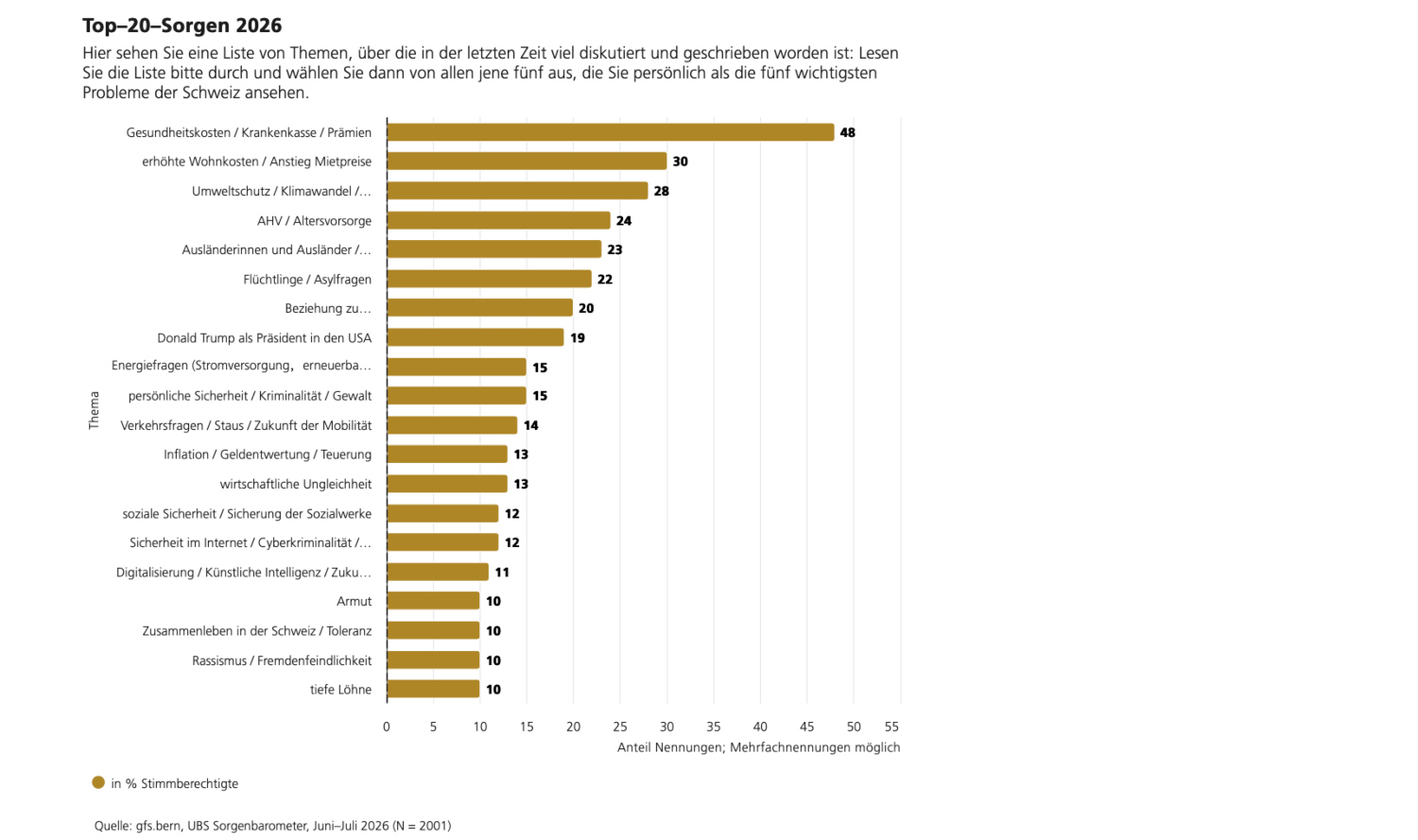
The biggest shift in the worry ranking is recorded for digitalization and artificial intelligence. It rises from 30th place last year to 16th place. Despite this increase, it still does not rank among the most frequently cited concerns.
Views on artificial intelligence are also mixed. Sixty-nine percent of respondents say they use AI, and 24 percent even use it daily. At the same time, 43 percent see the risks of the technology as greater than its opportunities. By contrast, 35 percent rate the opportunities more highly.
Fear of AI-related job losses is rising
Fear of losing one’s own job to AI is not high, but it is rising noticeably. Seventy-five percent of employed people still consider a technology-driven job loss in the next five years unlikely. Previously, that figure stood at 86 percent. In contrast, 18 percent of respondents now fear that their job is likely to be automated — more than double the level of three years ago and a new high. Driven by the rapid rise of generative AI, the effects of technological change are becoming increasingly tangible for workers and are feeding ever more strongly into individual risk perceptions.
The Swiss education system is viewed mostly positively by respondents: 70 percent consider it up to date and adapted to future needs. For 90 percent, dealing with artificial intelligence and digital technologies is one of the key future skills.
This year, for the first time since 2023, an absolute majority says Switzerland should align itself more closely with a unified EU position in order to strengthen its negotiating power vis-à-vis the major powers (51 percent). By contrast, support for an independent niche policy is declining and now stands at just 37 percent.
Preferring to look backward
To mark the 50th anniversary of the Worry Barometer, respondents were also asked whether they would rather live in Switzerland in 1976 or in 2076. Fifty-one percent chose 1976, 24 percent chose 2076, and one quarter were undecided. Reasons given for preferring the past include, above all, a


