


Private credit: The next phase of growth
Private credit refers to loans and other credit instruments issued through private offerings. Because the debt does not trade on public markets, it is less liquid than traditional fixed income. In return, investors have the potential to access attractive income, accretive total returns and genuine portfolio diversification versus listed credit.
Key characteristics of private credit
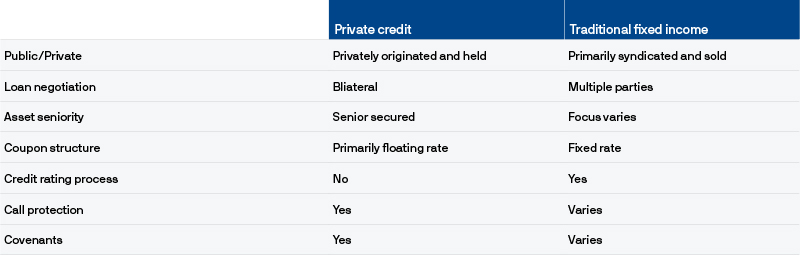
Source: J.P.Morgan Asset Management: as of 3/31/26
Ways to invest
Investors can access private credit directly, through primary investments in private credit funds, or through secondary transactions. The right route depends on return targets, liquidity needs, fee tolerance and governance preferences.
As the landscape continues to evolve, investors drawn to the yield, risk-return profile and diversification benefits should start by deciding which strategies best fit their objectives and existing fixed income allocations.
Benefits of private credit
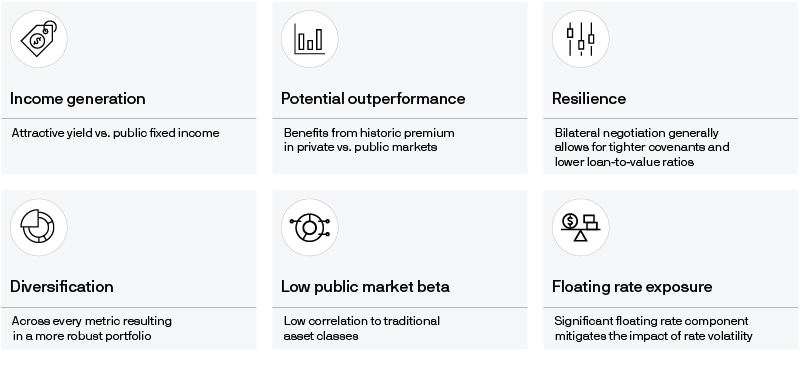
Source: J.P.Morgan Asset Management: as of 3/31/26
Two main categories
Corporate lending and asset-backed finance are the two major types of private credit. Each spans several sub-strategies with distinct risk and return profiles, from senior secured direct lending and mezzanine debt to special situations, consumer finance and real-estate-backed credit.
That breadth lets investors shape exposure around specific goals: steady income, inflation protection, downside resilience or more opportunistic upside through complex or distressed situations. Floating-rate structures can also help cushion portfolios against rising rates, while asset-backed deals bring collateral and amortisation into the mix.
The next phase
After a period of rapid growth, especially in direct lending, the market is entering a more mature phase. Returns are likely to be driven less by broad beta and more by manager skill, sector positioning and underwriting discipline. Spreads have tightened, so security selection matters more than it did a few years ago.
We expect wider dispersion across managers and sectors. That reinforces the case for diversification across strategies, geographies and vintages, and creates meaningful opportunities for experienced investors who can source, structure and actively monitor deals through the full credit cycle.
Want more detail?
Read the full private credit primer for a deeper dive into strategies, risks, returns and portfolio construction: Read the full article (PDF)

This is a marketing information communication. The views contained herein are not to be taken as advice or a recommendation to buy or sell any investment or interest thereto. Reliance upon in this material is at the sole discretion of the reader. Any research in this document has been obtained and may have been acted upon by J.P. Morgan Asset Management for its own purpose. The results of such research are being made available as additional information and do not necessarily reflect the views of J.P. Morgan Asset Management. Any forecasts, figures, opinions, statements of financial market trends or investment techniques and strategies expressed are, unless otherwise stated, J.P. Morgan Asset Management’s own at the date of this document. They are considered to be reliable at the time of writing, may not necessarily be all inclusive and may be subject to change without reference or notification to you. The value of investments and the income from them may fluctuate in accordance with market conditions and investors may not get back the full amount invested. Past performance and yield are not a reliable indicator of current and future results. There is no guarantee that any forecast made will come to pass.
Our EMEA Privacy Policy is available at www.jpmorgan.com/emea-privacy-policy.
This communication is issued in Europe (excluding UK) by JPMorgan Asset Management (Europe) S.à r.l.


