


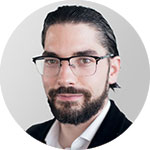
Brandon Yarckin: «Switzerland Is a Natural Home for Us»
Mr. Yarckin, when we last spoke, Universa was eying Switzerland for a new office. Where do things stand today?
It has been a very good year for us, and we continue to grow, particularly in Switzerland. We have a lot of active, ongoing dialogues with Swiss investors, and our message keeps resonating — not only with Swiss investors, but generally.
What is that core message?
We always come back to the same point: if your risk mitigation makes you poorer at the end of the day, what is the point? Why use bonds, why use hedge funds, why use other forms of risk mitigation if the goal is to create wealth? Risk mitigation and wealth creation are usually at odds. What we do, on both a relative and an absolute basis, is flip that narrative on its head. We can provide risk mitigation and, at the same time, raise the rate at which our clients compound their capital relative to other forms of risk mitigation. We cannot comment on performance, but broadly speaking we continue to outperform other forms of risk mitigation, and we have happy clients.
What is your timeline for opening a Swiss office?
We are hoping for the first quarter of 2027.
What was the mission of this trip? Did you meet investors, look at office space?
It was primarily about meeting investors. On this trip I was fully booked with investor meetings while I was in town, so it was really about the dialogues rather than office space.
«Our existing Swiss clients are primarily on the high-net-worth private banking side.»
Mainly on the institutional side, so pension funds?
Pensions, mostly. We had one very large wealth advisor, and the rest were pensions. There has been a lot of demand from the Swiss pension landscape — funds trying to maintain their funded status after such a big rally in markets.
What sentiment did you encounter towards your tail-risk strategy?
Very positive. I think we solve problems that these organizations cannot solve otherwise — we add an arrow to the quiver of asset allocation that they would not have had. It is a new tool that fixes a specific problem. Because it is new, some people take a little time to get comfortable with it, but there is a lot of positivity and understanding, and we are very transparent about how we work with these institutions.
You have also built a technology tool for this. Can you explain it?
Yes. We have a tool called Bernoulli — named after Daniel Bernoulli (1700–1782), effectively the patron saint of Universa, and a nod to his Swiss origin. It lets pension funds translate their own asset allocation, incorporate tail hedging, and see the effects. They can take their portfolio allocation, input it into Bernoulli, and the output is something they can see is better than what they had before. That is really the goal.
Did you meet mostly prospective or existing clients?
On this trip, only prospective clients. I did not meet the existing clients this time — purely because of travel and scheduling, not for any other reason.
For the rest of the year, what is your CIO's view on markets? Will it stay as calm as it has been?
Our CIO, Mark Spitznagel, has been vocally very bullish since 2022, and he remains bullish. Around six months ago he put out an 8,000 target on the S&P, and he would reiterate that it is probably going higher, above 8,000. Even in March, when Wall Street flipped bearish and everyone thought the market would accelerate a sell-off because of Iran, he was the lone voice keeping everyone level-headed, saying: this is not the crash, this is a bear trap. And here we are, after one of the biggest short-term rallies in history. He has been calling for a blow-off top in equities for four years, and we are in the early stages of that. We do not know how long it will last or how far it will go — only that it will go further. At the end of it, we would expect the potential for a crash as big as any we have seen in a hundred years. But there will be no precise bell that rings to say «this is it.» Is the interim level 8,000 or 9,000? You will not know. You have to be positioned for it to turn — which it certainly will.
«Switzerland is my favorite country outside the U.S.»
Why are your activities centered on the Swiss pension system rather than the private banks and independent wealth managers?
We actually have both. Our existing Swiss clients are primarily on the high-net-worth private banking side — those dialogues simply started earlier. More recently, our conversations have shifted towards the pension side, so it is really a matter of the pensions catching up. Wealth managers can move faster; pensions take a little more time to digest something new. Right now we have five different, very large, very active dialogues with Swiss pensions.
To end on a personal note — you have been here several times. What do you like about Switzerland?
Switzerland is my favorite country outside the U.S. It is beautiful — the mountains, clean, efficient. I like the Swiss culture, the food is great, there are the natural activities, and it is very peaceful. It is a great place to be, so I feel privileged for any amount of time I get to spend there.
Brandon Yarckin is Chief Operating Officer of Universa Investments, the tail-risk hedge fund founded by Mark Spitznagel and advised by «Black Swan» author Nassim Nicholas Taleb. He has been with the firm since 2007, taking the COO role in 2019. A Duke University graduate, he previously worked in equity derivatives and convertible bond sales at KBC Financial Products.


