



Private banking test: Liechtenstein comes out ahead
The testing unit Fuchsbriefe Prüfinstanz presented its "TOPS 2027" ranking of the best banks and wealth managers in the German-speaking world in Berlin on Wednesday. It is the 24th edition of the test, which is run by Berlin-based publisher Fuchsbriefe, a subsidiary of academic publisher Springer Nature.
The winner is Frankfurt-based Rothschild & Co Vermögensverwaltung, with 84 out of a possible 100 points. It is followed by Neue Bank (83 points) and Kaiser Partner Privatbank (82 points), both based in Vaduz. A mere five points separate first place from sixth.
One Swiss firm among 16
The only Swiss entrant to reach the final is Frankfurter Bankgesellschaft (Schweiz). The Zurich-based private bank, owned by Germany's Sparkassen-Finanzgruppe savings bank network, places tenth with 71 points and earns a "good" rating. Next in the Swiss country ranking are Reichmuth & Co Privatbankiers and Acrevis Bank, each of which scored less than half of the available points.
Switzerland also fares poorly across the board. The median score of the Swiss providers tested is 30.61 points, compared with 34.45 in Austria, 36.37 in Germany and 45.96 in Liechtenstein. Globalance stands out as well: Last year, the Zurich bank achieved 99 percent of the top score; this time it managed just 41 percent. The report does not say why.
The weak showing of Swiss banks in this test is no one-off. finews first reported on the phenomenon more than a decade ago (article in German).
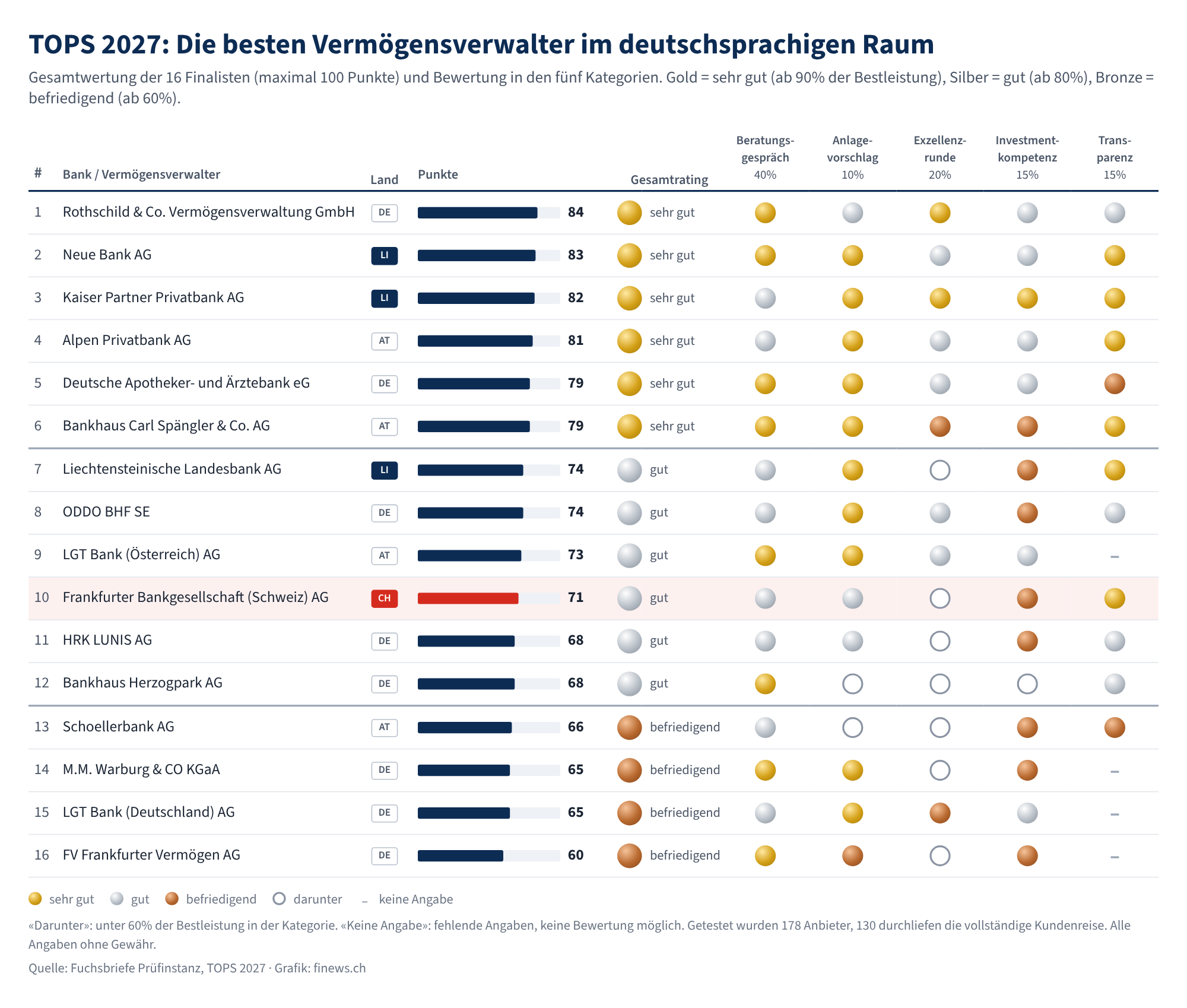
The 16 finalists in the TOPS 2027 test. Click here for a detailed view (source: Fuchsbriefe, chart: finews)
The test client shows up unannounced
Fuchsbriefe relies on undercover test clients and presents the banks with a new case every year. This time, the scenario was an heir with 5 million to 8 million euros (roughly $5.8 million to $9.2 million) to invest, plus a rented apartment building. The testers approached 178 banks and wealth managers; 130 of them went through the full advisory process.
One industry insider likens the method to the Michelin Guide: Visits are unannounced and anonymous. The scoring covers the advisory meeting (40 percent), the investment proposal (10 percent), a presentation to a jury (20 percent), investment expertise (15 percent) and transparency (15 percent).

The five test categories and their weighting (source: Fuchsbriefe, chart: finews)
Payment comes afterward
Fuchsbriefe charges no participation fees, and banks can neither sign up nor opt out. Money changes hands only after the test, chiefly through license fees for the use of the seal of approval. On its website, the publisher also lists special reprints and publications as sources of revenue.
Even so, the scoring is not entirely free of self-interest. Of the 15 transparency points, five are awarded for taking part in the publisher's own formats, namely the Fuchs Performance Project and the "Trusted Wealth Manager" trust review. The leadership is also new: Founders Ralf Vielhaber and Joerg Richter stepped back at the end of 2025. Since then, Stefan Ziermann and François Baumgartner have run the test, and the former "Fuchs | Richter Prüfinstanz" now operates as "Fuchsbriefe Prüfinstanz."
No appetite for a beauty contest
The meager Swiss result may also reflect a degree of reluctance. According to the industry insider, Swiss firms are especially wary of the jury presentation and of taking part in Fuchsbriefe's transparency formats. They are loath to have the performance of their mandates compared in isolation, since they see it as just one element of a far broader offering.
The report itself hints that such refusals occur. In cases of "self-selection," other providers may move up, the methodology notes say. For those who stay away, that has an upside: If you don't compete, you can't lose.


