


Foreign banks on the location Switzerland — Swiss companies on foreign banks
On Tuesday in Zurich, the Association of Foreign Banks in Switzerland (AFBS) presented the first "Foreign Banks in Switzerland Barometer". The commissioned study, written by the economic research institute BAK Economics, is based on a non-representative survey of foreign banks (61 responses) and Swiss companies (79).
Before discussing the results: The premiere of the study, available in German, French and English, is also noteworthy because AFBS, with its roughly 90 members, has until now generally communicated in a very restrained manner and, in particular, had never before invited the media to such a presentation. After Credit Suisse (CS) collapsed, however, it had become apparent that AFBS would become more open externally in its communications.
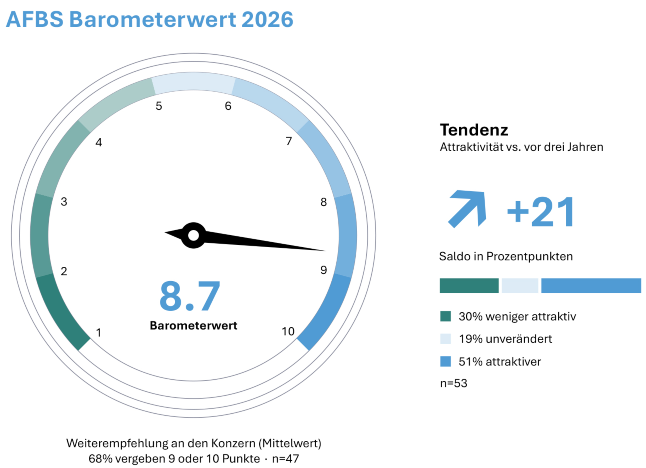
Overall favorable assessment of the Swiss market. (Graph: AFBS Barometer 2026)
The timing of the appearance is not bad. After CS exited, various foreign banks, in some cases with considerable publicity, announced that they wanted to expand their corporate banking business in Switzerland. From an economic perspective, that was certainly desirable, given the fear at the time that credit and other services for Swiss companies could become scarcer and more expensive (credit crunch). The study now provides indications of the position foreign banks actually hold in corporate banking today, three years after the upheaval.
In the first part, the foreign banks explained how they assess Switzerland as a location from the perspective of their international banking groups. The corresponding barometer value measures how likely it is that foreign banks would recommend further investments or an expansion in Switzerland to their parent companies. At 8.7, the value is quite high on a scale from 1 to 10.
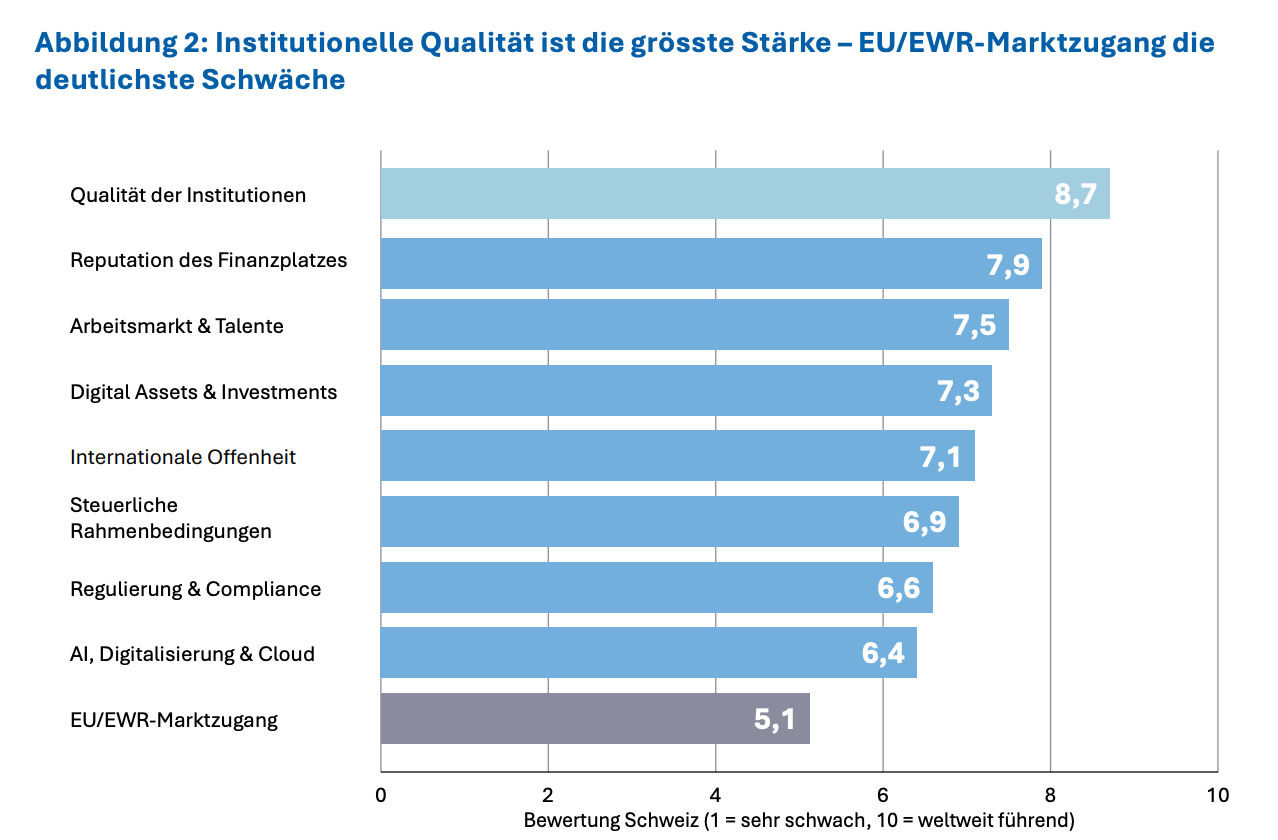
What foreign banks value more or less about Switzerland. (Graph: AFBS Barometer 2026)
The trend is also interesting: 30 percent of the banks rate Switzerland as less attractive than three years ago (shortly after CS collapsed), while 51 percent rate it as more attractive.
The overall assessment is based on nine key location factors. Switzerland scores weakest in regulation and compliance, in the area of AI, digitalization & cloud, and in market access to the EU and EEA.
Swiss companies appreciate foreign banks
In the second part, Swiss companies — the 79 responses came predominantly from larger, export-oriented industrial firms and should therefore be interpreted with caution — were asked to assess the role of foreign banks.
More than one-third already work with a foreign bank, and among those with an export share of more than 50 percent, the figure is more than three-quarters. Their international network and the banking group’s presence abroad are particularly valued. Seven in ten companies that use the services of a foreign institution said they could not easily replace it.
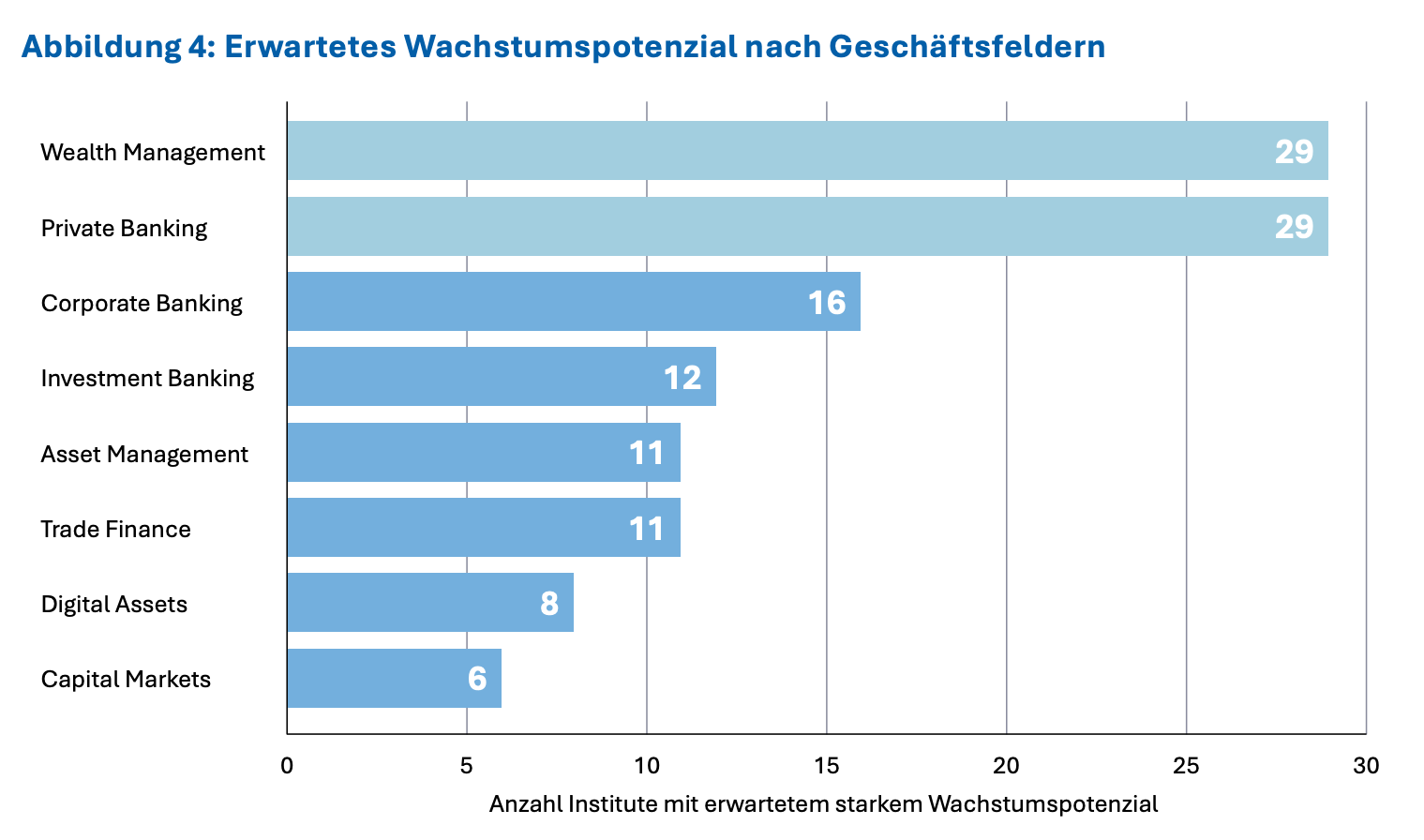
Many foreign banks also want to grow in corporate and investment banking. (Graph: AFBS Barometer 2026)
And what were the effects of CS’s collapse? Almost every fourth company either switched its main banking relationship or established an additional banking relationship as a result. That the upheaval left its mark is shown by the fact that numerous companies also cite higher financing costs, restrictions on credit limits and longer processing times as consequences.
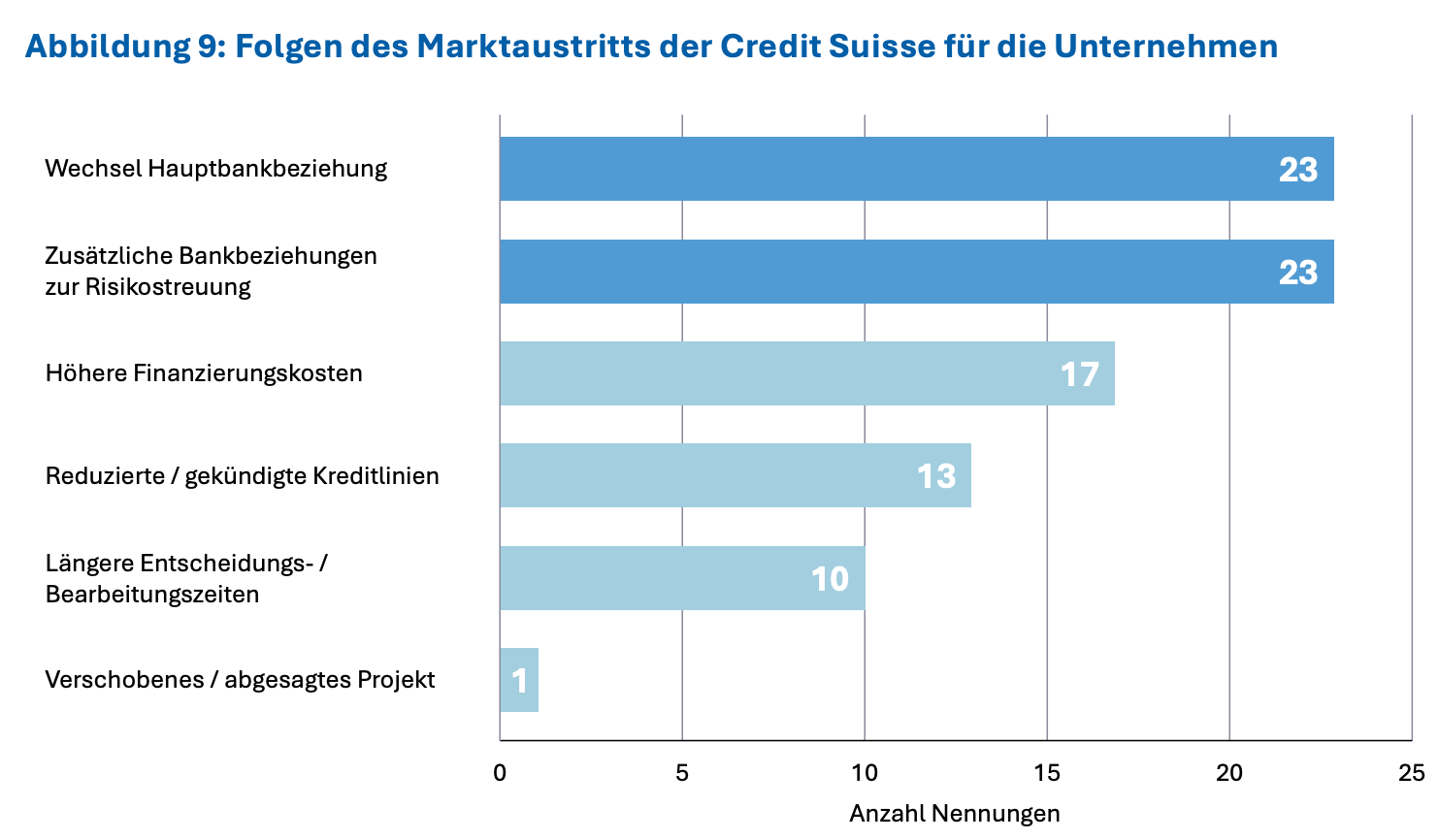
CS’s exit from corporate banking leaves its mark. (Graph: AFBS Barometer 2026)
At the media conference, which was led by AFBS Chairman Adrian Nösberger, AFBS Secretary General Raoul Würgler and BAK Chief Economist and study director Claude Maurer (who worked for many years as a bank economist at CS), journalists were mainly interested in the first part.
Foreign banks also need a national champion
Nösberger made a case for a diverse Swiss banking landscape. "That creates competition and gives customers options. A national champion that can compete on the global stage is part of that too," he said, referring to the debate over a possible departure of UBS, the last Swiss major bank.
Maurer pointed out that the relatively favorable assessment of the location factor Digital Assets & Investments, compared with the AI criterion mentioned, does not indicate a general weakness in technology. According to AFBS, the especially strict Swiss regulation of data protection and privacy is evident in the area of AI, because it also restricts the cross-border exchange of data needed for AI and cloud applications.
Financing base from Swiss retail banking is lacking
Würgler sought to temper overly high expectations of foreign banks as lenders. "Capital is necessary to finance loans, and deposits from retail banking are an advantage for that." But precisely this segment, which is intensively pursued by cantonal banks and UBS, is not a strength of foreign banks.
Würgler also spoke plainly about relations with the EU: "EU regulation has long made it difficult for Swiss banks to conduct business in the EU from our country. But with new directives, the EU is now also making it more difficult for potential clients to use services from Swiss banks."
"Swiss finish" as a hindrance
When it comes to regulation, the secretary general is especially bothered by the "Swiss finish," a term that was once not exclusively negative in connotation.
As an example, he cited the implementation of Basel III. Switzerland set much more ambitious deadlines for this than other countries and did not use the room for maneuver in capital requirements in favour of banks (and thus in favour of the smoothest possible supply of credit to the economy). The fact that no exception was made for short-term lending is now having a negative impact on the financing of commodity trading transactions, Würgler explained.


