


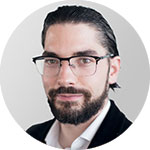
Sener Arslan: «We want to be the dominant player»
Mr. Arslan, you have been with QPLIX for almost two years. How did you come to join the company?
My career has taken me through a mix of wealth management and technology. I worked at UBS, ran my own independent asset management practice, and later moved to the technology side at another portfolio management system provider. Most recently, I served as Group COO and CEO at a large multi-family office, where I worked closely with single-family offices and ultra- and high-net-worth clients.
When I decided to move into WealthTech, I looked specifically for players that met certain criteria: sufficient scale and substance to grow sustainably; an owner-led model that enables long-term strategy; genuine ambition to expand; and a modern software architecture. QPLIX checked every box.
Where does your interest in technology come from, given your background on the client-facing side?
From my own experience with inefficiency — both in asset management and at banks. You quickly realize that without the right tools, you cannot create real efficiency, work at speed, or optimize processes. So much of that is technology-driven.
Once I saw how much technology can compress, consolidate, and analyze data — and how compelling that world is — I was hooked.
What do you value most about the QPLIX product?
QPLIX is a genuine platform — not a patchwork of best-of-breed solutions with CRM, portfolio management, and reporting scattered across different tools. On QPLIX, you can cover all instruments: liquid and illiquid, across every asset class. The core system includes CRM with KYC and AML capabilities, full portfolio management with more than 350 indicators, order management with direct bank connectivity, and a fully white-labelable client portal including a mobile application — all within a single ecosystem. We have also connected more than 250 international custodian banks, with more being added continuously.
«Since I joined, we have signed more than 30 clients in Switzerland alone.»
How has QPLIX been received in the Swiss market?
Very strongly — almost surprisingly so. Since I joined, we have signed more than 30 clients in Switzerland alone. Over the past two years, we have onboarded nearly 18 new asset managers and won several single-family offices. There is broad interest in the market. What is often missing is a trusted counterpart on the vendor side. Once you build that trust, present real solutions, and address specific pain points, clients are willing to invest. What does not work are half-measures or strategies that keep shifting. QPLIX has stayed the course for almost 14 years. That resonates.
Did QPLIX have to adapt its product for the Swiss market?
Yes, and it was not entirely straightforward. Swiss regulators have different requirements than Germany or the UK — think FINIG and FIDLEG. That required adjustments on the CRM side. There are also different instruments, different interfaces to accounting software and ERP systems. What made the difference was our agile development approach: we ship a new release every two weeks. That allowed us to address Swiss market requirements very quickly.
How has the Swiss office developed?
I started alone. Today we are a team of ten in Switzerland, with a growing product delivery function — people who onboard and support clients. Longer term, the founders plan to establish dedicated development capacity here as well. Munich is close, we are in constant exchange, and that helps enormously.
What trends are driving QPLIX's growth?
I see three layers. First, family offices: illiquid assets are still largely managed manually. Everything we can automate and feed into analysis is a strong tailwind for us. Second, the external asset manager market: growth is significant, and the questions are consistently the same — how do I work more efficiently, digitize processes, and connect everyone from relationship manager to end client? Third, banks: we are seeing institutions looking to break up the value chain — reducing dependency on core banking systems and bringing in more specialized tools. That is exactly where QPLIX fits.
«You upload any document — a private equity capital call, a transaction from a bank without an interface — and the system extracts the data, pre-books it in QPLIX, and a single click confirms the entry.»
Is QPLIX already established as a solution for banks in Germany?
There was an official announcement earlier this year: Deutsche Bank has selected QPLIX to serve its end clients, family offices, and external asset managers. That has sparked interest from other banks as well. The trend toward disaggregating the value chain is as pronounced in Germany as it is in Switzerland.
Would QPLIX work in an Avaloq environment, which most private banks in Switzerland run?
Yes. We have already integrated Avaloq and other core banking systems. Every bank has its own architecture — some run systems like Avaloq, others have proprietary builds. The know-how we have accumulated across these projects is an asset in every new conversation.
What real estate functionality does the platform offer?
We can capture a property in full: rental income, lease agreements, cash flow calculations, cost accounting, all documentation — from the building level down to the individual floor. Looking five years out, you can see your full cash flow position, all income, all expenses. QPLIX is not a real estate management system in the narrow sense, but for the investment and portfolio side, it covers everything you need.
What is on the development roadmap for the rest of this year?
Three areas. First, AI: all data is hosted on local servers — in Switzerland for Swiss and international clients, in Germany for German clients. Models are hosted locally; data does not leave the system. We have launched an AI-powered document reader: you upload any document — a private equity capital call, a transaction from a bank without an interface — and the system extracts the data, pre-books it in QPLIX, and a single click confirms the entry. This is genuine AI comprehension, not OCR, and it works regardless of language. Second, a chat function: you can ask directly within the tool which bonds mature in the next 90 days, or say «generate a report» and get the answer instantly. Third, we are building a dedicated relationship manager portal — a standalone interface for RMs in the field who need rapid access to client data, AML cases, and portfolio analytics.
Is that financially intensive development work?
On the AI side, yes — it is a domain that evolves constantly and requires ongoing investment. More broadly, we do not develop in isolation from the market; we develop with it. Certain features we build together with clients, at no additional cost to them. That strengthens our market position.
Where do you want to take the Swiss business in the medium and long term?
In the medium term, we continue growing across three segments: single-family offices, independent asset managers — Switzerland has close to 1,800 registered EAMs, so the opportunity is substantial — and banks looking to outsource parts of their value chain. Long term, we want to be the dominant player in Switzerland for single-family offices and external asset managers. We are also eyeing pension funds and insurance companies: they need to consolidate their holdings, run asset-liability management, and conduct stress tests. All of that is within QPLIX's scope.
Sener Arslan has served as Regional Director Switzerland at QPLIX — a Munich-based provider of wealth management software for family offices, private banks, and external asset managers — since April 2024. Prior to that, he was Group COO of Taurus Global Wealth and CEO of Taurus Wealth Holding in Zurich from 2020 to end-2023, where he led global strategy development and the integration of international Taurus entities. From 2019 to 2020, Arslan headed international sales and business development at Expersoft Systems, having previously served as Senior Sales Manager for Switzerland, Germany, and the UK. In 2015 and 2016, he was Chief Investment Officer at Gigant Swiss Consulting in Zurich. Arslan began his career at UBS, where he worked from 2010 to 2015 as an investment advisor and subsequently as a program manager in the Wealth Management Investment Mandates division. He holds the Chartered Financial Analyst (CFA) designation.


