


Do Collateralized Loan Obligations Deserve a Place in the Standard Allocation?
Their reputation was left in tatters following the global financial crisis of 2008, and many investors steered well clear of them for years: collateralised loan obligations (CLOs). These securitisations typically bundle together a large number of syndicated loans, i.e. loans extended jointly by several banks, usually to larger companies.
The banks transfer these loans to a special purpose vehicle (SPV), which then issues bonds on the capital market and uses the proceeds to finance the acquisition of the underlying assets. This instrument was developed around 30 years ago, as US banks began withdrawing from traditional lending activities, to provide relief for bank balance sheets.
Refined into Investment Grade Through Tranching
The creditworthiness of the underlying borrowers is generally relatively low, falling below the investment-grade threshold. Nevertheless, these loans can be used to create top-rated bonds with a triple-A rating through tranching, i.e. dividing the securities into different risk categories.
"Before the financial crisis, you really could package almost anything into CLOs or collateralised debt obligations (CDOs). At the time, I saw issuances that included credit default swaps (CDS), synthetic credit products, subprime mortgages and even preferred stocks," confirms Dennis Deane, Client Portfolio Manager at Janus Henderson since 2025, in an interview with finews at the British asset manager's Zurich office.
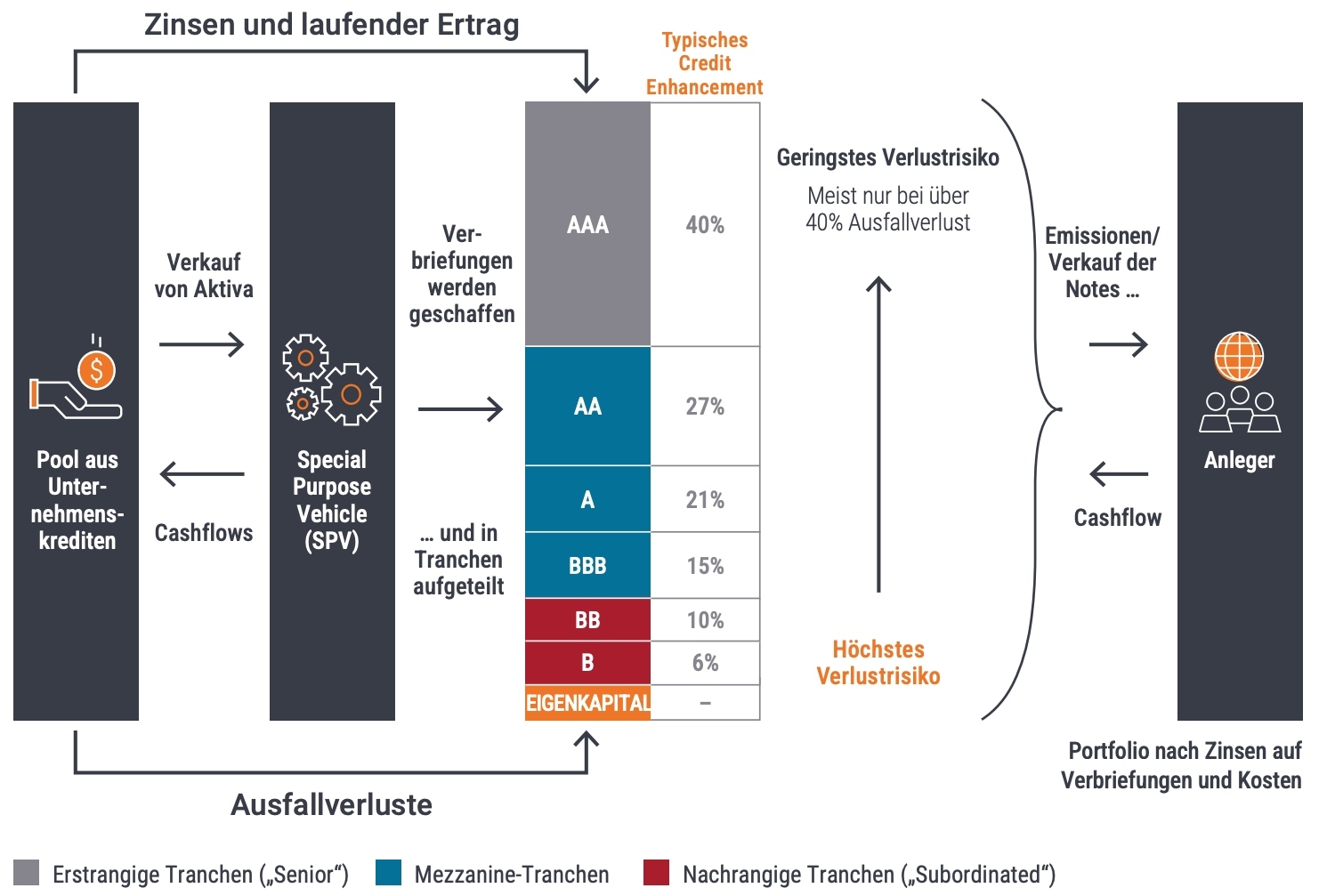
How CLO deals are structured. (Graph: Janus Henderson)
Deane certainly knows what he is talking about. He knows the international bond markets inside out. He began his career in 1999 at Paine Webber, selling taxable fixed-income securities. The US investment bank was acquired by UBS in 2002 (for a rather hefty price). Deane remained with the Swiss banking giant until 2023, holding positions including Head of Fixed Income Solutions and Head of Financial Institutions Strategy, Middle Markets, based in New Jersey and New York, respectively.
To recap: Excesses in the US subprime mortgage market were widely regarded as the root cause of the 2008 financial crisis. These low-quality loans were also packaged into securitisations and effectively transformed into triple-A-rated securities through tranching. During the crisis, however, it became apparent that subprime mortgages were much more highly correlated, and therefore far less diversified, than the models used by banks and rating agencies had suggested.
Transformation of the CLO market
As a result, payment disruptions and defaults also occurred across many other segments of the securitisation market. Financial institutions invested in these markets were forced to write down increasingly large amounts. Uncertainty spread rapidly around the globe, and confidence in the international financial system collapsed.
Deane emphasises that even back then, during a historically unprecedented period of market stress, triple-A-rated CLO tranches did not suffer any losses. Nevertheless, the industry has changed significantly since then. "Today, virtually 100% of CLOs consist of corporate loans, meaning the collateral is much cleaner than it was back then. Standards have also become considerably stricter. In the segment in which we operate, there have been no defaults among CLOs rated BBB or higher since the global financial crisis."
"CLOs are much cleaner today than before the financial crisis. In addition, stricter standards apply."
Yet the legacy of the financial crisis continues to resonate. "Even today, I still have to explain to Swiss investors just how much the market has changed and why these complex structures do not pose a risk." Deane is a firm believer in the asset class. In his view, CLOs should be a core component of standard fixed-income asset allocations for both institutional and private investors. Highly rated securitisations remain underrepresented in many portfolios.
Regulation is currently providing an additional boost. With the revision of Solvency II, capital requirements for high-quality CLOs are being reduced for European and Swiss insurers – according to Deane, "an important selling point" for top-quality securitisations. Janus Henderson offers CLOs backed by loans to US and European companies through segregated mandates and exchange-traded funds (ETFs) denominated in US dollars and euros.
Diversification Matters Here, too
But how has the CLO market changed since 2008? "Apart from the fact, as already mentioned, that virtually only loans to companies are now securitised in this way, Deane points out that there are additional mechanisms and contractual provisions also serving to protect investors, particularly those relating to overcollateralisation and interest payments.
Diversification is another key consideration. An individual loan may account for no more than 1% to 2% of the entire CLO, and care is taken to ensure exposure to a range of industries. A typical securitisation comprises around 200 individual loans. "Thanks to their structural safeguards, CLOs typically experience lower default rates than corporate bondsThanks to these characteristics, CLOs have better credit quality than corporate bonds," Deane observes.
Not a Question of Timing
But is now a good time to invest? For years, the credit cycle has been unusually benign, with significantly fewer companies defaulting than historical experience would suggest. However, the possibility of a reversal or normalisation of the cycle is not, in Deane's view, a reason to delay investing in CLOs.
For Deane, the most important argument is the structure itself, particularly the buffer provided by the lower-rated tranches. He illustrates this with a calculation: "For a triple-A tranche to be affected, losses would have to amount to at least 35% of all underlying loans. And I am talking about actual losses here, not defaults. The default rate would therefore have to be considerably higher still – reaching a level never seen before in history." When a borrower is unable to service its debt, the entire outstanding amount is recorded as a default. However, the actual loss rate, after the recovery of assets, is generally significantly lower.
"For a triple-A tranche to be affected, losses would have to amount to at least 35 percent of all loans. The default rate would have to be significantly higher still — as high as it has ever been in history."
The yield spread offered by CLOs over US Treasuries ranges between 100 and 130 basis points, a comparatively narrow range. Deane attributes this premium to the complexity of the instruments and the information asymmetry between CLO issuers and investors.
CLOs pay floating interest rates linked to a three-month reference rate and therefore carry significantly less interest-rate risk than conventional bonds. Given this characteristic, their closest competitors are not so much longer-dated government or corporate bonds. Instead, Deane competes primarily with money market funds and Treasury bills (short-term US government securities).
"The rise in short-term interest rates has led to significant inflows into short-duration fixed income, including the CLO market," he notes. Although yields at the long end of the yield curve have also risen sharply in recent months, the substantial interest-rate risk associated with high volatility remains a deterrent for many investors.


