


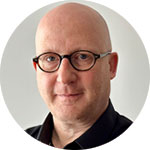
Active ETFs: Fidelity wants to shake up the Swiss market with new products
The Swiss market remains an attractive destination for international asset managers. That is also evident at Fidelity International. The global asset manager ended its fiscal year, which closed at the end of September, in Switzerland with revenue growth of almost 60 percent, as country head Pascal Schuler told finews.
According to Schuler, what is particularly pleasing is that the growth was not driven by individual investment products or short-term trends, but by broad demand for different investment strategies.
High-yield bonds particularly in demand
Schuler draws a comparison with soccer: the success is not due to a single superstar, but to a team of eleven consistently strong players. Fidelity is benefiting from broad-based demand. According to Schuler, the most sought-after strategies include European high-yield bonds and income-oriented solutions such as Global Short Duration Income.
A strategic focus is on active exchange-traded funds. Fidelity is one of the largest players in Europe in this area. Schuler sees considerable potential, especially in Switzerland. While acceptance of active ETFs is already high here, demand varies greatly depending on the client segment.
Fidelity targets Swiss banks
Independent asset managers, family offices and smaller pension funds were among the early adopters. Larger pension institutions and traditional banks, by contrast, remain somewhat cautious in some cases. This is not least due to organizational reasons. An active ETF combines the tradability of an exchange-traded fund with an investment strategy whose success cannot be measured solely by the closest possible replication of an index.
For banks, the question therefore arises whether such products should be handled by their ETF specialists or by the research and advisory teams responsible for active funds. "It is not just about tradability, but about where the alpha comes from and how it can be achieved sustainably," Schuler explains.
New products are designed to protect investors from price losses
Fidelity also wants to drive its active ETF business forward with new investment concepts. Schuler is placing particularly high hopes on so-called outcome-oriented strategies, in which the targeted investment result takes center stage. These include income-oriented ETFs and so-called buffer ETFs. The latter are intended to protect investors from price declines within a defined loss range without completely giving up participation in rising equity markets.
However, the protection is limited and by no means comparable to a full capital guarantee. Schuler considers such concepts particularly interesting in the current market environment. Many younger investors have never experienced a prolonged and pronounced stock market correction. "You don't buy insurance after the house has already caught fire," Schuler says.
Warning signs in the U.S. stock market
In fact, the head of Fidelity Switzerland is watching developments on the stock markets with a degree of skepticism. In particular, the high valuations of U.S. technology companies and the enormous investments in artificial intelligence raise questions for him. The multi-billion-dollar investment programs will sooner or later have to generate corresponding returns. At the same time, the risk is increasing that the rally, which has so far been heavily concentrated in a handful of tech stocks, will lose momentum.
From his perspective, this means above all one thing for investors: diversification and more careful stock selection are becoming increasingly important. That could also make conditions more favorable again for active management.
Fidelity strengthens its presence in Geneva
The asset manager's growth ambitions are not limited to new products. Fidelity is also expanding its personnel resources in Switzerland. Geneva is particularly in focus. Until now, the company has been represented there in sales by two people. Another person is set to join in early 2027.
Schuler justifies the expansion with the special structures of the financial center in western Switzerland. While Zurich is strongly shaped by large banks, independent asset managers and family offices play a particularly important role in Geneva. Accordingly important are local presence, linguistic proximity and personal relationships.
With the planned additions, Fidelity will have a total of seven employees in sales in Switzerland, including Schuler. This is in addition to roles in marketing and sales support. The head of Switzerland does not rule out further personnel expansion steps, although there are currently no concrete plans.


