


Why Switzerland Outperforms Germany
Both central-bank balance sheets have expanded dramatically since the turn of the century. The Swiss National Bank enlarged its balance sheet primarily through large-scale foreign-exchange interventions, while the Eurosystem expanded through substantial public-sector bond purchases.
Abb. 4: Entwicklung des Preisniveaus
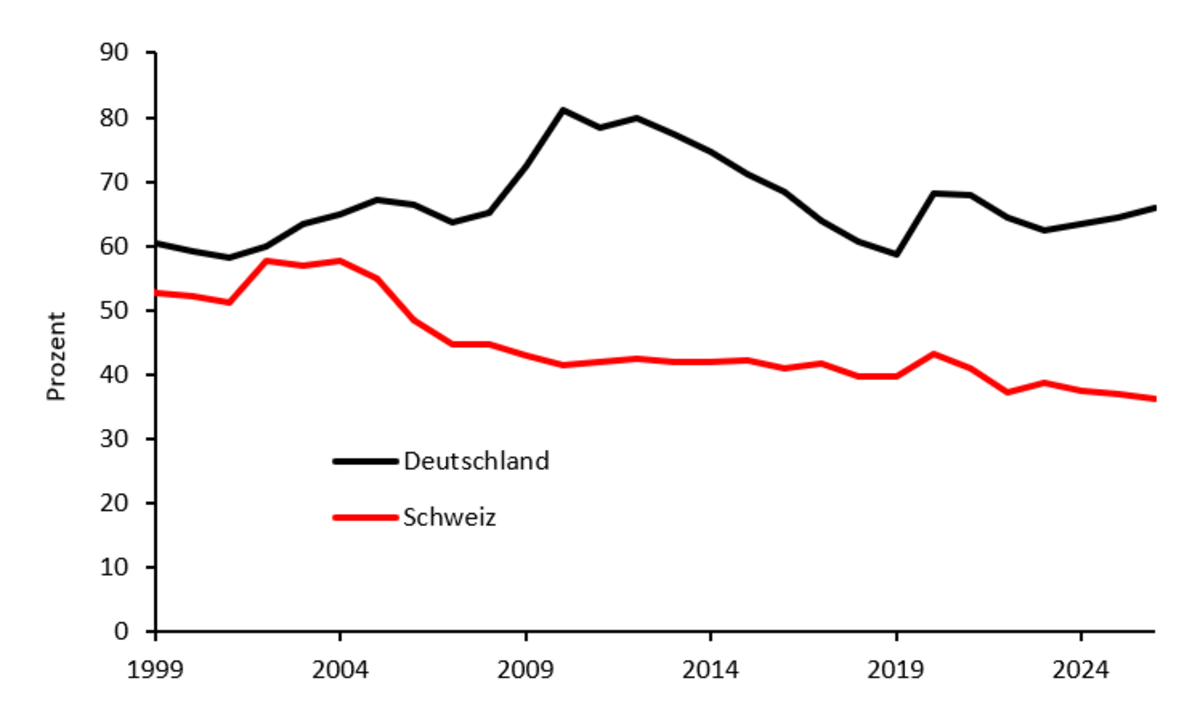
(Source: OECD und Oxford Economics)
Despite this balance-sheet expansion, consumer-price inflation remained relatively moderate in both countries, with the exception of the inflation surge in 2021 and 2022. Switzerland, however, experienced greater price stability overall. Asset prices rose significantly, particularly residential real estate prices in Switzerland.
Different Risk Profiles
The risk profiles of the two central banks differ substantially.
The Swiss National Bank is primarily exposed to exchange-rate risk. An appreciation of the Swiss franc reduces the franc value of foreign assets, as illustrated by the CHF 132 billion loss recorded in 2022.
The German Bundesbank faces no direct currency risk on its holdings but carries significant political risk through its TARGET2 claims on the ECB. A breakup of the euro area would potentially expose it to substantial losses.
In addition, the ECB’s interest-rate hikes since 2022 have generated significant losses for the Bundesbank, which reported deficits of EUR 19.8 billion and EUR 9.8 billion in 2024 and 2025, respectively.
The institutions also differ in their interpretation of their mandates. The ECB has expanded its role into banking supervision, climate-related policies, and potentially central bank digital currencies. The Swiss National Bank has remained comparatively focused, avoiding an active role in climate policy and limiting its CBDC efforts largely to wholesale applications for financial institutions.
Abb. 5: Anteil der Sozialausgaben nach Abgrenzung des IWF
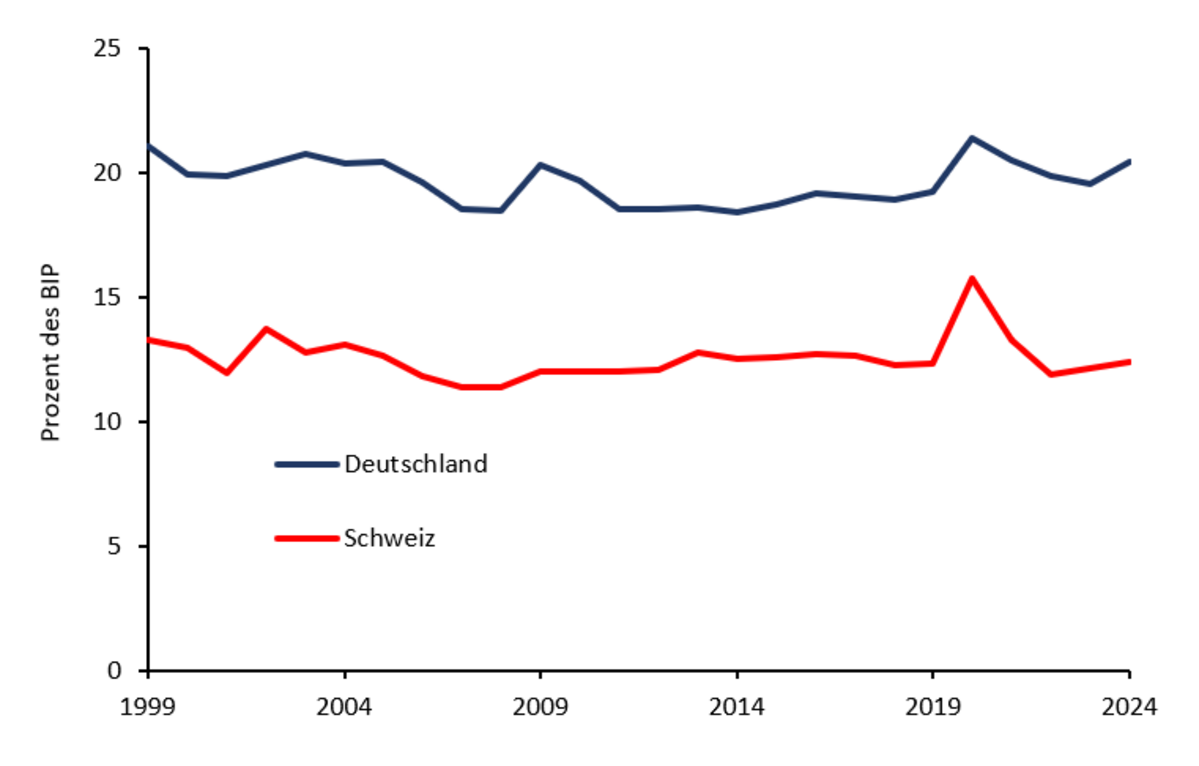
(Source: IWF, General Government Expenditure on Social Protection)
Regulation and Industrial Policy
Germany introduced a regulatory brake in 2015 but is known for implementing EU legislation particularly rigorously.
While the EU Taxonomy does not formally apply to Switzerland, it affects Swiss companies indirectly through financial markets and supply chains. The proposed Bilateral Agreements III could further align Switzerland with EU regulatory standards, potentially reducing Switzerland’s regulatory autonomy and altering its competitive positioning.
«Public-sector employment has risen sharply in both countries since 2007.»
Germany also relies far more heavily on subsidies. Depending on the methodology, annual subsidies amount to between EUR 117 billion and EUR 321 billion, equivalent to around 6–7 percent of GDP, with a significant share directed toward industry.
In Switzerland, subsidies total roughly CHF 50 billion, or 5.6 percent of GDP, but are concentrated mainly in agriculture, transportation, and social programs rather than industrial support.
Social Spending and Public-Sector Expansion
Social expenditures exceed 20 percent of GDP in Germany, compared with 12.5 percent in Switzerland. Part of this difference reflects Switzerland’s more decentralized welfare model, which places greater emphasis on occupational pensions as well as cantonal and municipal programs. Because local authorities are closer to specific social challenges, support measures can be tailored more effectively to local needs.
Nevertheless, demographic pressures are increasing in Switzerland as well, and social welfare has become the federal government’s largest spending category.
Public-sector employment has risen sharply in both countries since 2007. In Germany, this expansion has often coincided with declining efficiency in areas such as rail transport, education, and public infrastructure projects.
Switzerland’s public sector has expanded by a similar magnitude, yet without comparable signs of deteriorating service quality. Swiss railways continue to achieve high punctuality rates, and public infrastructure projects rarely experience major cost overruns. One explanation may lie in institutional structures that provide more predictable planning and approval processes.
Germany’s Future Competitiveness Depends on Reform
Government spending amounted to roughly 30 percent of GDP in Switzerland in 2025, compared with approximately 50 percent in Germany. This is widely viewed as a robust indicator of greater economic freedom in Switzerland.
Although public spending has also increased significantly in Switzerland since 2007, the expansion has been considerably less pronounced than in Germany.
Regulation also appears less burdensome in Switzerland, with direct democracy serving as an important check on policies driven primarily by political interests or lobbying groups.
Another key distinction lies in monetary policy. The introduction of the euro effectively marked Germany’s departure from the stability-oriented monetary framework traditionally associated with the Bundesbank. Since then, the euro has steadily depreciated against the Swiss franc.
As a result, German exporters have been relieved of what some economists call the «productivity whip» — the continuous pressure to improve efficiency that accompanies an appreciating currency. In Switzerland, that mechanism remains intact and continues to support international competitiveness.
This is also reflected in unit labor costs. While they have remained broadly stable in Switzerland since 2008 and increased only modestly since 2020, Germany has experienced a substantially stronger rise.
Notably, the sharp increase in government spending and public-sector employment since 2008 has not undermined the resilience of Swiss industrial production. On the contrary, industrial output continued to grow alongside public-sector expansion. Germany has not experienced a comparable outcome.
Looking ahead, the future competitiveness of the German economy will depend heavily on structural reforms—reforms that may prove politically difficult to implement given the European Union’s complex decision-making framework.
Abb. 6: Lohnstückkosten
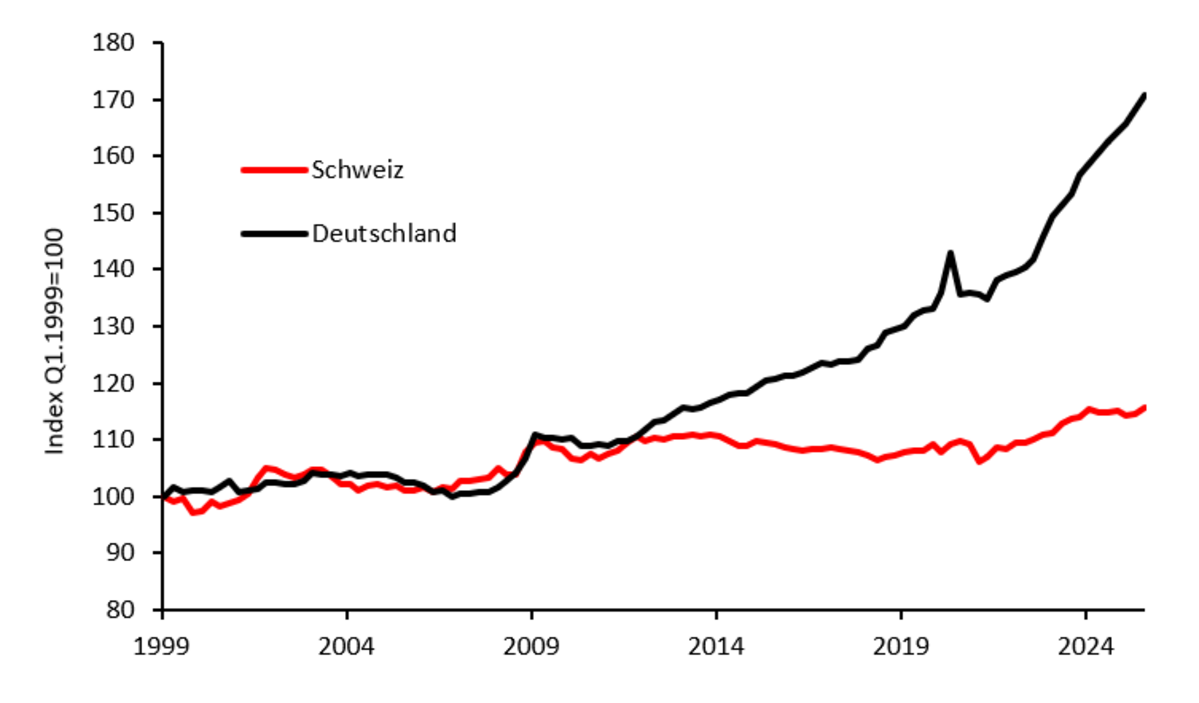
(Source: OECD)
Gunther Schnabl is Director of the Flossbach von Storch Research Institute.
Christoph Schaltegger is Director of the Institute for Swiss Economic Policy at the University of Lucerne.
- Read all previous guest contributions here.
- << Back
- Page 2 of 2


