


Why Switzerland Outperforms Germany
In this column, guest authors share their views on economic and financial issues.
Europe’s export-oriented economies are facing mounting pressure. Russia’s war against Ukraine continues to impose significant financial burdens on Europe. U.S. President Donald Trump’s tariff policies have disrupted global trade, while the conflict with Iran is pushing oil and gas prices higher. At the same time, China is increasingly losing momentum as a global growth engine and is challenging European industry through export subsidies. Against this backdrop, a key question for Europe’s open economies is which institutional and economic policy frameworks best enhance resilience.
Swiss Employees Work Significantly More
Against this backdrop, a comparison between Germany and Switzerland is particularly revealing. Both countries are highly developed, export-driven economies with strong industrial foundations. Yet Switzerland has clearly outperformed Germany in recent years.
One illustration is GDP per capita. In Switzerland, GDP per capita currently stands at CHF 81,710, compared with CHF 43,740 in Germany. Even after adjusting for purchasing power, Switzerland still enjoys an advantage of roughly 25 percent.
A similar pattern emerges when looking at wages. Switzerland’s median gross monthly salary of CHF 7,024 is around 80 percent higher in nominal terms than Germany’s equivalent figure of approximately EUR 3,900. After accounting for Switzerland’s higher cost of living, however, the real purchasing-power advantage narrows to about 20 percent.
Swiss employees also work significantly more. Average weekly working hours amount to 42.5 hours in Switzerland, compared with roughly 40 hours in Germany. Part of the higher nominal wage differential is therefore earned through longer working hours and less leisure time.
Higher Wealth, But More Unequally Distributed
Economic growth has slowed in both countries, but since the turn of the century Switzerland has achieved average annual growth of 1.8 percent, compared with 1.1 percent in Germany.
There is, however, an interesting paradox. Once population growth—particularly immigration into Switzerland—is taken into account, GDP growth per capita has been broadly similar in both countries.
Even so, Switzerland performs better across a range of broader prosperity and competitiveness indicators. Life expectancy is higher, Switzerland ranks slightly ahead of Germany in the Human Development Index, unemployment is lower, and the tax and social contribution burden on employees is lighter. Household wealth is also substantially higher, although more unevenly distributed than in Germany.
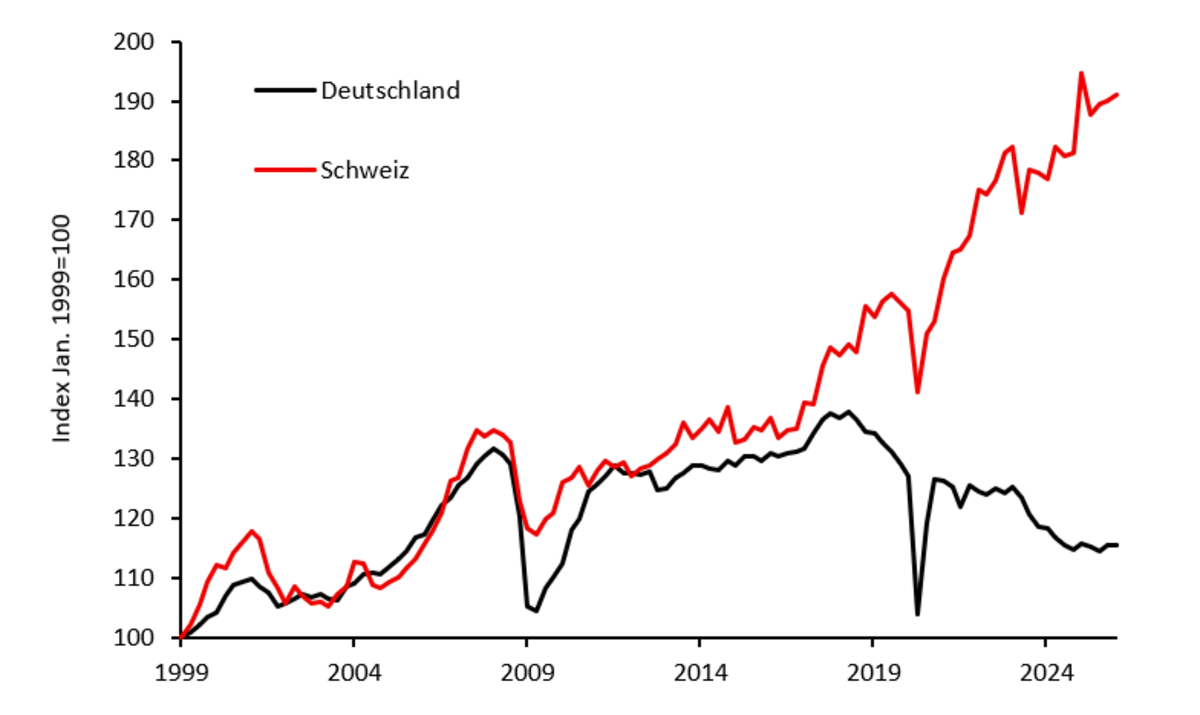
While industrial production in both countries moved largely in parallel for many years, their paths diverged decisively after 2019. Industrial output has declined noticeably in Germany since then, whereas Switzerland has continued to expand production.
This divergence is remarkable because both economies are deeply integrated into European and global value chains, are highly export-oriented, and have been exposed to similar external shocks.
Abb. 1: Industrieproduktion
(Source: Oxford Economics)
Why, then, has Switzerland been more successful in maintaining industrial value creation under increasingly challenging global conditions? And to what extent can this difference be attributed to macroeconomic factors such as fiscal, monetary, and economic policies?
Germany Relaxes Its Debt Rules
Government spending structures also differ.
Since 2003, Switzerland’s federal debt brake has ensured that government spending does not exceed revenues over the economic cycle. Similar fiscal rules exist at the cantonal and municipal levels, although they vary across jurisdictions.
The European Union’s fiscal framework, by contrast, has often been breached by member states, including Germany. Since the Covid-19 pandemic, many of these rules have effectively been suspended.
Germany’s constitutional debt brake, introduced in 2016, limited the federal government’s structural deficit to 0.35 percent of GDP, while the Länder and municipalities were required to maintain balanced budgets.
«The European Union’s fiscal framework, by contrast, has often been breached by member states, including Germany.»
However, in February 2025 Germany loosened its debt brake to facilitate additional spending on infrastructure and defense. Parts of the newly created fiscal space have since been redirected toward social spending.
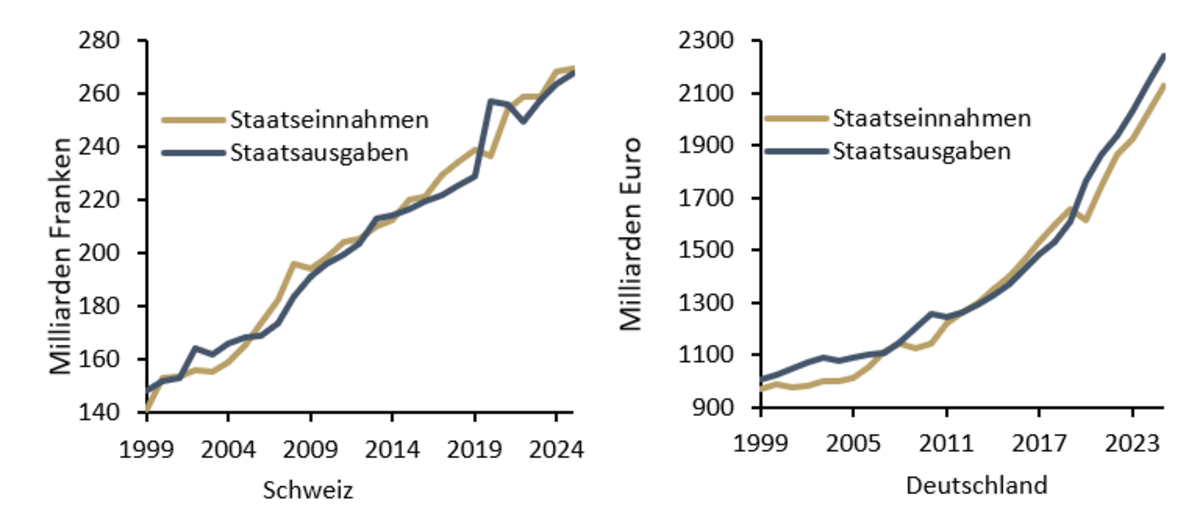
Since the onset of the global debt crisis in 2007, government revenues and expenditures have increased by roughly 50 percent in Switzerland, compared with approximately 100 percent in Germany. Since the pandemic, German expenditures have significantly outpaced revenues, whereas Switzerland’s overall public-sector budget has remained broadly balanced.
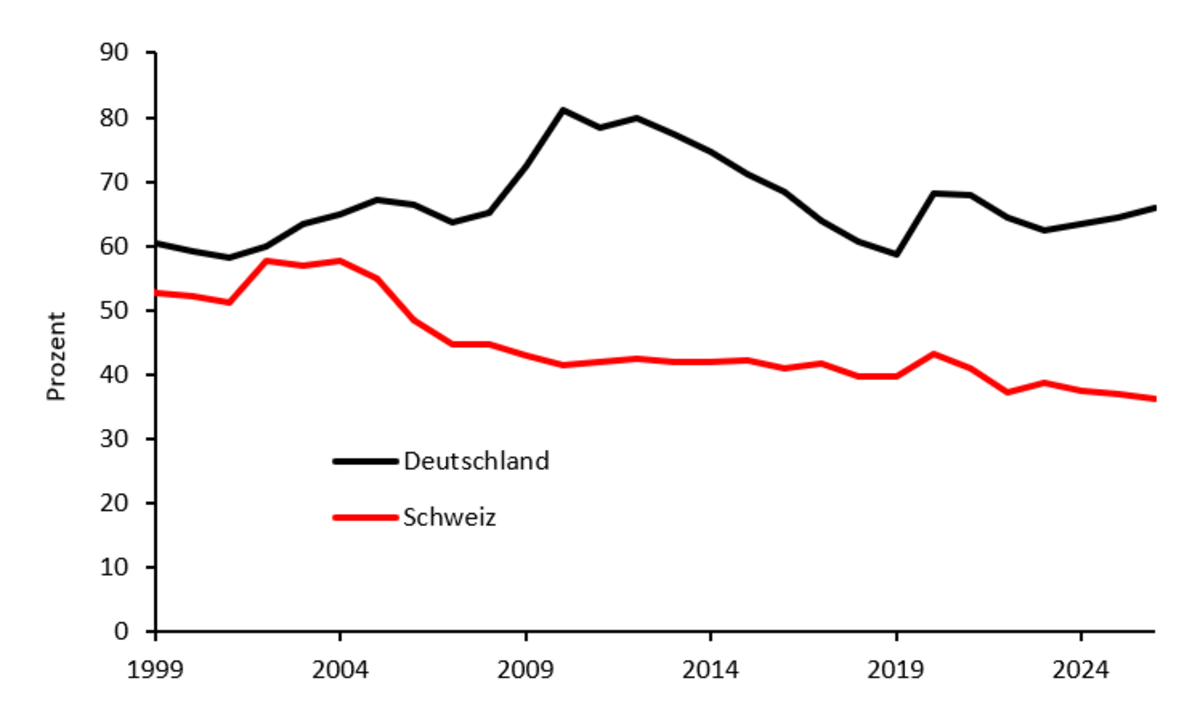
Government debt amounted to approximately 63 percent of GDP in Germany in 2025 and is expected to rise toward 100 percent by 2035 following the easing of fiscal constraints. Switzerland’s debt ratio, by contrast, stood at around 36 percent and is expected to continue declining.
Switzerland Requires Clear Funding for Additional Spending
In Germany, excluding social security funds, around 40 percent of public spending is accounted for by the federal government, 37 percent by the Länder, and 23 percent by municipalities.
In Switzerland, the equivalent distribution is 34 percent for the federal government, 43 percent for the cantons, and 23 percent for municipalities, reflecting a more decentralized system.
Direct democracy, fiscal rules, tax referendums, and public votes on special funding initiatives reinforce the principle in Switzerland that additional spending should be accompanied by clearly identified funding sources.
Germany, meanwhile, has seen rising financial burdens for municipalities stemming from EU-driven regulation and federal legislation, often without adequate compensation.
Abb. 2: Staatseinnahmen und Staatsausgaben
(Source: LSEG, IWF)
Abb. 3: Staatsverschuldung als Anteil am BIP
(Source: OECD)
Different Constraints on Monetary Policy
The central banks of both countries are constitutionally independent and accountable to their respective legislatures. Nevertheless, their policy flexibility is constrained for different reasons.
- Germany holds a maximum of two votes on the 27-member Governing Council of the European Central Bank, despite accounting for nearly a quarter of euro-area economic output. The structural majority of southern euro-area countries, many with higher debt levels, creates persistent pressure toward a more accommodative monetary stance.
- Switzerland, meanwhile, conducts monetary policy independently. However, as a small open economy, it remains heavily influenced by ECB decisions through exchange-rate dynamics. Switzerland’s traditionally lower interest-rate levels reflect expectations of long-term appreciation of the Swiss franc against the euro.
- Page 1 of 2
- Next >>


