


Swiss Blockchain Federation: How Switzerland can keep pace in financial infrastructure
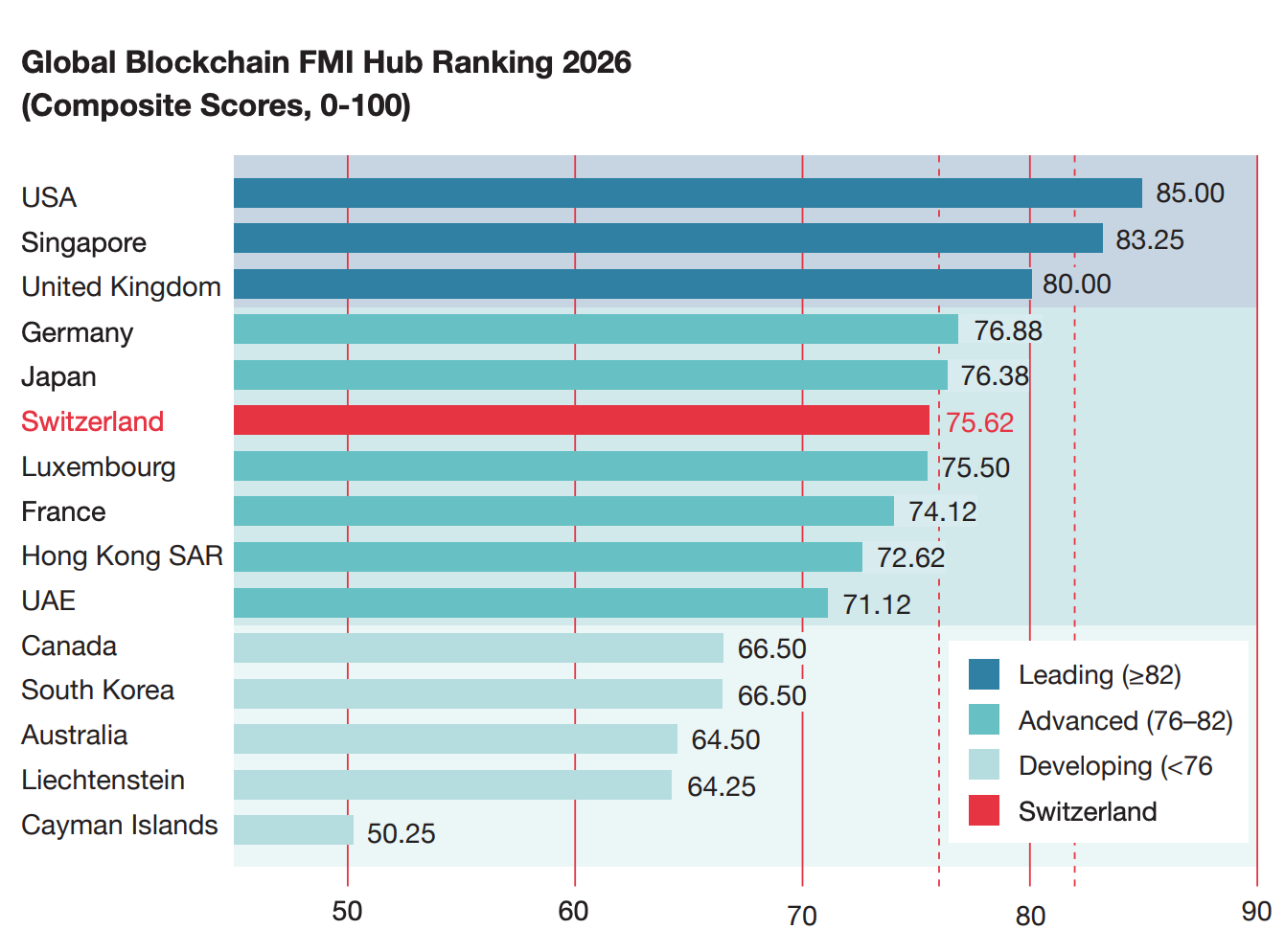
According to the "SBF Global Benchmark Report 2026", presented on Tuesday at the Zurich offices of the business law firm MME, Switzerland ranks 6th out of 15 international financial centers.
The study, produced for the first time by the Swiss Blockchain Federation (SBF) with support from Amina Bank and MME, compares financial centers using 11 criteria, focusing on the future viability of infrastructure for tokenization, distributed ledger technology (DLT), blockchain and digital assets.
In addition to the ranking and country profiles, the study includes an analysis of Switzerland's strengths and weaknesses, international case studies, and "recommendations on regulation, digital forms of money, market access, interoperability, cyber resilience and the link between AI and blockchain," as it says.
Graphic: SBF Global Benchmark Report 2026
According to the SBF, technology is not the only focus. At the presentation, CEO Pascal Ihle emphasized that this is about the core infrastructure of the financial system of the future and thus also about value creation and skilled jobs, in other words, issues of strategic importance.
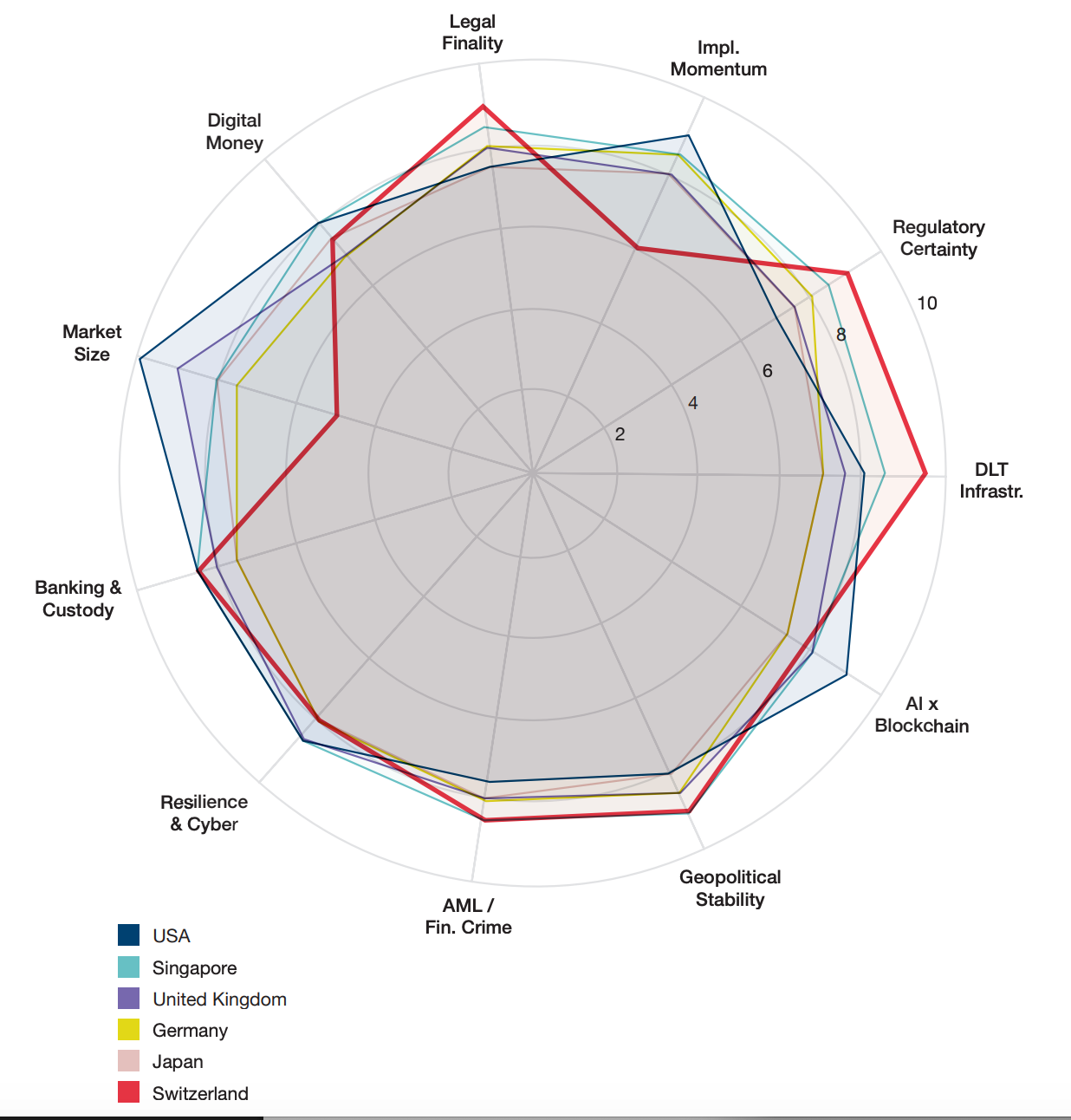
Ranking ahead of Switzerland are the United States, Singapore, the United Kingdom, Germany and Japan. The study's diagnosis is not new: Switzerland got off to a very good start (for example, with the DLT Act), has a high degree of legal certainty and a strong ecosystem with specialized banks and custodians. Our country remains a strong location, but its lead is steadily eroding because other financial centers have caught up and the financial market supervisory authority Finma apparently interprets its role differently than it did a few years ago.
Graphic: SBF Global Benchmark Report 2026
According to the study, the greatest need to catch up exists in three areas.
- Too slow an implementation pace: There is a lack of practical framework conditions for Swiss franc stablecoins (the revision of the Financial Institutions Act (FinIA) is currently under way; Finma's lengthy procedures "slow down the conversion of legal certainty into new business models and productive applications.")
- Market depth is too limited, liquidity is lacking, and international connectivity is insufficient: Swiss market infrastructures, banks and custodians should become cross-border compatible and gain access to international issuers, investors and trading venues. "Without this networking, even first-class infrastructure remains below its potential."
- Need to catch up in AI × blockchain and talent: Switzerland's strengths in research and education are only rarely turned into scalable applications for compliance, risk management, cyber resilience and settlement.
MME partner Andreas Glarner provided practical examples of where Finma runs into problems. Rulings (advance decisions) sometimes took two or three years, and in some cases the assessments were completely different from what had been expected and from what prevailing doctrine held. Some applicants for fintech licenses (the licensing category was originally created to promote innovation) had already been waiting three years. In addition, Finma usually uses its leeway when changing practice (Finma would probably speak of a "clarification" of practice) to the detriment of the industry, with the prominent example of stablecoins.
Speculation about the reasons for Finma's change of course
SBF could not identify the one reason for Finma's course over the past few years, which has been strictly focused on avoiding risks and is a major topic throughout the financial industry. But the discussion made it clear that several factors are likely at play, such as the experience of the Credit Suisse debacle or the lack of federal council members with an affinity for blockchain and the like. And Germany, where former Finma director Mark Branson heads the Bafin supervisory authority, was described as a model for Switzerland in implementing regulation, which says a lot.
Many of the demands set out by SBF on the basis of its diagnosis are also not entirely new.
- Innovation and pace at Finma should be strengthened. Innovation should once again be explicitly anchored as a strategic objective. Licensing procedures must become clearer, faster and more predictable.
- A practical framework should be created for Swiss franc stablecoins and digital forms of money.
- International market access should be improved through corresponding agreements with other countries.
- Liquidity and market networking should be deepened by giving Swiss market participants access to international trading, custody and settlement platforms.
- Technology and talent should be brought to market more quickly. To this end, research, the financial industry and infrastructure operators must jointly advance applications of artificial intelligence in blockchain, compliance, cyber resilience and programmable settlement.
The study does not recommend that Switzerland imitate New York, London or Singapore. Rather, it should position itself in a niche as a trustworthy, neutral and internationally connected center for institutional digital assets.


